
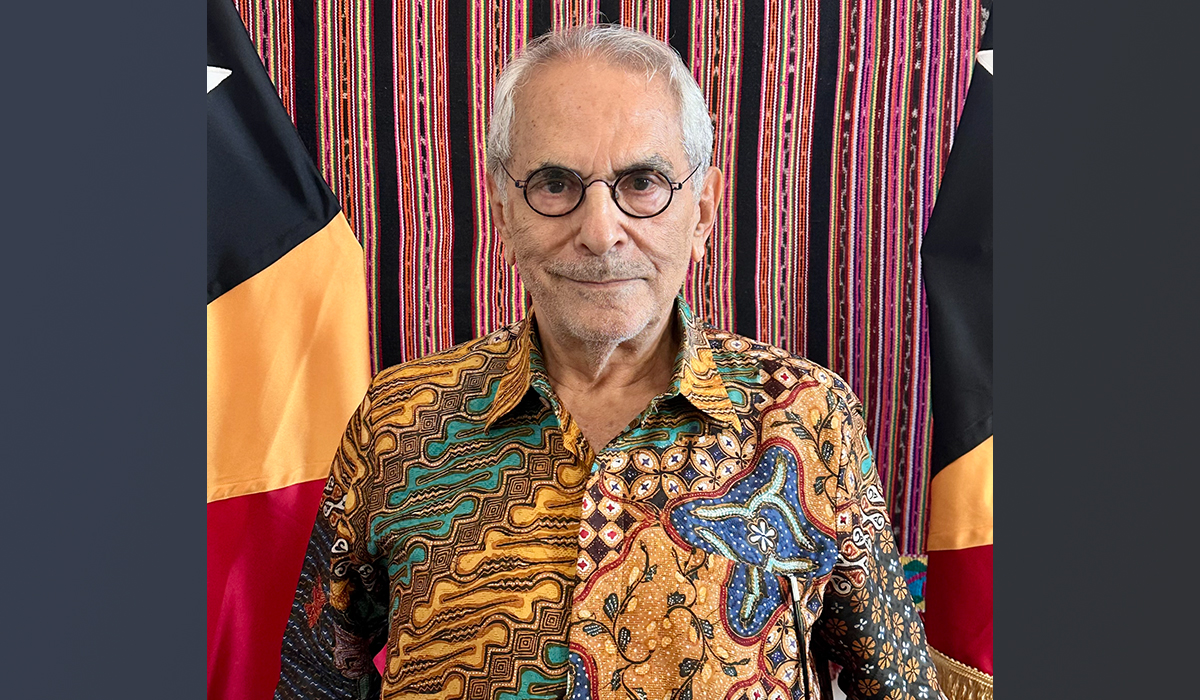
04 Dec Interview with José Ramos-Horta, President of Timor-Leste
As President of Timor-Leste, what is your vision for the country’s development over the next three years, and what steps are you taking to achieve it?
In Timor-Leste, executive power rests with the Prime Minister, who leads decisions on economic development, investment, and key sectors like fisheries and forestry. My role as President is largely symbolic and constitutional, similar to a parliamentary monarch, though I do hold some substantive powers. I work closely with Prime Minister Xanana Gusmão to foster peace and stability so the government can govern effectively.
Our shared vision is to maintain peace and eliminate extreme poverty, especially child malnutrition and stunting. But vision alone is not enough—plans succeed only with leadership, integrity, and execution. Since taking office in 2023, and particularly in 2025, this government has restored direction after inheriting a dysfunctional system from the previous administration. The 8th government, led by Taur Matan Ruak, lacked governance capacity and dismantled a sophisticated financial management system, wasting millions and disrupting progress. Much of 2023 and 2024 was spent repairing this damage. Only now, in 2025, are we seeing real progress in rural infrastructure, education, healthcare, agriculture, and investment. The economy is finally showing growth.
Timor-Leste will become ASEAN’s 11th member in October – what does ASEAN membership mean for the country’s economic development and diplomatic positioning?
I have long advocated for Timor-Leste’s ASEAN membership, even when few saw its value. I first raised the idea in 1974 during a visit to Jakarta, and in 2011, as President, I formally submitted our application to ASEAN through then-Chairman, President Susilo Bambang Yudhoyono. The process began that year despite initial skepticism.
After leaving office in 2012, I served in various international roles, including the UN and the Global Commission on Drug Policy, though I stepped back from active participation to focus on my presidency. In 2021, encouraged by many—including Prime Minister Gusmão—I ran for President to restore Timor-Leste’s international profile. Securing ASEAN membership, which will be finalized on Oct. 26, is a top priority. I have also strengthened ties with China, Australia, and especially Indonesia, and promoted closer relations with Singapore, Malaysia, the Philippines, Thailand, Vietnam, Cambodia, Laos, Brunei, as well as South Korea, Japan, and India. I have built strong relationships with leaders such as Prime Minister Modi and President Xi Jinping, advancing these diplomatic priorities.
What is driving Timor-Leste’s economic momentum, which sectors offer long-term potential, and how is your government attracting investment and building local capacity?
By 2026, I am confident Timor-Leste’s economy will grow at least 5%, fueled by public investment and rising foreign interest. A major Japanese shipbuilding company has established operations and plans its first vessel by 2028. We are welcoming a Korean cosmetics manufacturer, and a $100 million private solar energy project backed by Japan and France. Expansion of Dili International Airport, set to begin this year, will boost tourism and trade. We are close to finalizing the Greater Sunrise pipeline deal, which promises significant investment even before production starts. With higher agricultural productivity and more trade, Timor-Leste is firmly on a path to sustained growth.
How are you developing tourism to attract high-value visitors, particularly from the U.S., while benefiting local communities?
I support community-based tourism and homestays rather than large-scale five-star resorts, which often strain water and infrastructure while delivering limited benefit to the local economy. Tourists can use up to 100 liters of water daily per person, adding pressure on systems. Having traveled to over 135 countries, I’ve seen that tourism creates the most value when local communities supply food and services. We aim for sustainable tourism that directly benefits families and communities. Billionaires with luxury yachts are welcome only if their presence contributes onshore. Tourism must empower locals—not just employ them as service staff, but make them true participants in the economy.
Which sectors should American investors focus on, and how can Timor-Leste and the U.S. collaborate to support mutual growth?
We live in uncertain times, and stable partnerships require predictable policies. The U.S. helped shape global trade through the WTO, yet recent years have seen abrupt tariffs and disruptions, often tied to domestic issues or long-term wars. That said, visionaries like Elon Musk are welcome here—no taxes, just bring talent and help us grow. I do not believe in state-run enterprises. Government’s role should focus on regulation, security, and creating the right environment, while the private sector drives development. Public-private partnerships, especially leveraging our $18 billion sovereign wealth fund, can attract serious investors. Prudence is essential with Greater Sunrise revenues.
How is your WTO membership reshaping Timor-Leste’s trade priorities, and what are your main goals for expanding exports and joining global supply chains?
International law and the multilateral system built since World War II have been crucial for maintaining peace and global prosperity. When these rules are ignored or disrespected, everyone loses. Big powers risk conflict, and poorer countries suffer. International law—covering the seas, war, human rights and diplomacy—was developed over centuries to ensure stability and coexistence. The post-WWII order, which the U.S. helped create, has benefited all, including the U.S. itself. Now, with tariffs and trade disruptions, we risk destroying the very system that has allowed prosperity to grow.
What final message would you give readers considering Timor-Leste as a business and investment destination?
I envision Timor-Leste as a new financial and logistics hub. Asia’s four billion people currently rely on a few centers—Singapore, Shanghai, and Dubai—and Timor-Leste is well positioned to join them. We aim to become a regional hub for air cargo, aircraft maintenance, and maritime shipping.
Our modern automated port, managed by Bolloré, the world’s largest container company, could attract significant traffic. We also see opportunities in pharmaceuticals, electronics, and shipbuilding. Ship repair capacity has long been my focus. Previously, vessels had to travel to Surabaya, Indonesia, for maintenance. With ASEAN’s 700 million people and a $4 trillion economy nearby, Timor-Leste offers strategic opportunities for investors with expertise and vision.
Sorry, the comment form is closed at this time.