
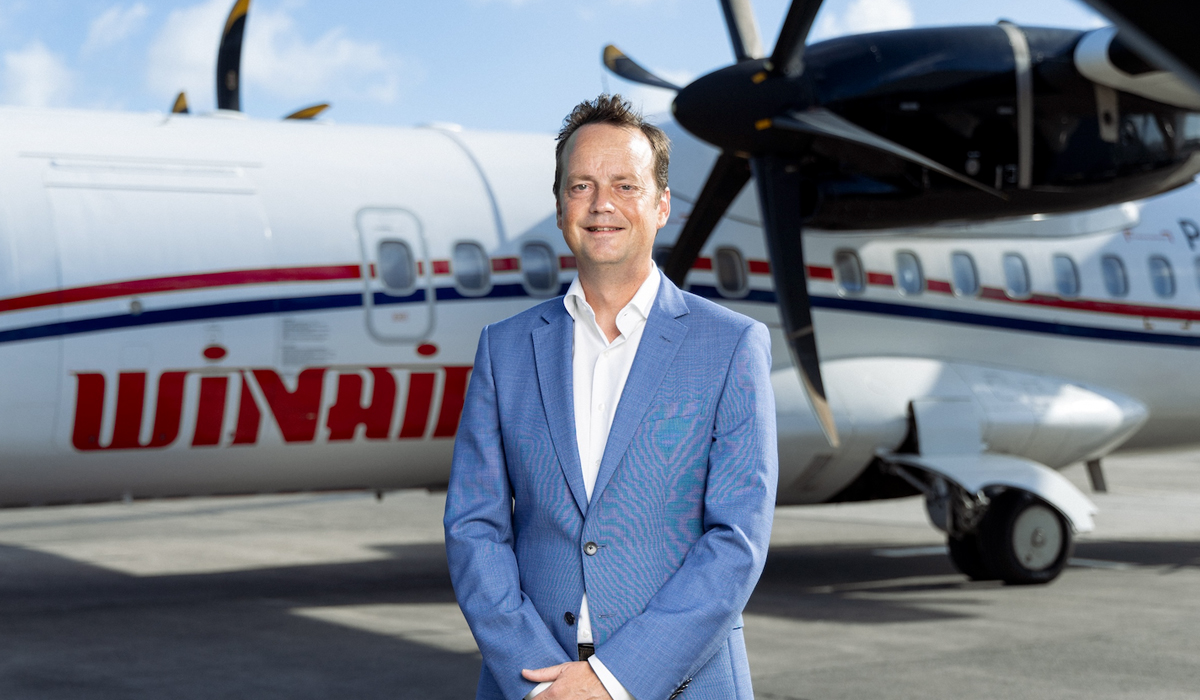
06 Jul Interview with Hans van de Velde, CEO Windward Islands Airways International (Winair), Sint Maarten
Sint Maarten punches far above its weight as a tourism hotspot. In Q2 2025 alone, airport arrivals rose 16.9% and cruise arrivals 14%. Major U.S. airlines such as JetBlue, American Airlines and United have added new routes to meet demand. What do you see as the main drivers behind the recent surge in tourism and why are travelers choosing Sint Maarten?
Part of the explanation is quite practical: for travelers coming from the U.S., Sint Maarten is the first major Caribbean island they reach and it has the region’s largest airport and strongest hub. This creates a self-reinforcing dynamic: being the biggest hub attracts more attention and more flights — a position built over the last 20–30 years. Sint Maarten is especially well known on the U.S. East Coast, particularly in the New York and Boston areas. Its role as the main regional hub also gives tourists the unique advantage of staying in Sint Maarten while easily exploring the surrounding islands — something not commonly found elsewhere in the Caribbean.
How are recent infrastructure upgrades strengthening Sint Maarten’s position as a high-end destination, from the modernization of Princess Juliana International Airport to new luxury hotel developments?
Sint Maarten was hit hard by Hurricane Irma in 2017 and for years our airport was in disarray. A good airport may not be a major gamechanger, but a bad one is a clear dissatisfier — and for six years, arriving and departing passengers did not have a pleasant experience. Now, with a completely rebuilt terminal, we have the best airport in the region and visitors are relieved to see this improvement.
With 25 years in tourism and aviation, I know that tourism growth depends on strong infrastructure and airline capacity working together. Travelers don’t choose a destination because flights exist; they choose it for hotels, beaches, culture and activities. That is why investment in quality, recognizable hotel brands is crucial for Sint Maarten. Our main market is the U.S. East Coast, but if we want to attract travelers from the West Coast, we must understand their preferences and invest in the experiences and brands that matter to them.
You have previously highlighted challenges for regional airlines like Winair, including small scale and limited local traffic. How are aviation leaders turning these hurdles into opportunities to boost visibility and connectivity across the Caribbean?
We are proud to be the region’s oldest airline, serving the Caribbean for 65 years. That longevity shows we have a clear and sustainable place in the market. Our success depends on combining local and international passengers — relying on only one is impossible in a region of very small islands, some with just 2,000 residents. That is why we operate 20- to 50-seat aircraft. Our commercial partnerships with airlines like JetBlue, United, Air France and KLM allow us to fill about 50% of our seats with international passengers — and on some routes, up to 80%.
By balancing both markets, we have built a strong, resilient network and achieved steady growth. Many Caribbean airlines have failed by expanding too aggressively, so our focus is on stable, sustainable growth.
Winair is the region’s oldest airline and a key pillar of Sint Maarten’s connectivity. The carrier has maintained profitability, expanded its fleet and deepened partnerships with global airlines. Could you briefly outline Winair’s historical role and contribution as Sint Maarten’s legacy airline?
Winair has been connecting the small islands around Sint Maarten for decades. Islands like Nevis, St. Kitts, Saba and St. Eustatius rely heavily on Sint Maarten for their daily needs and economic activity. St. Barts, in particular, depends on Sint Maarten as its lifeline — we carry about 100,000 passengers there every year. Over 40–50 years, this has allowed us to build a stable and reliable organization. In the past eight years, we have expanded beyond the immediate area to destinations like Barbados, St. Lucia and Trinidad. Our growth strategy is careful and financially disciplined, which is why we succeed where more aggressive regional airlines have failed.
In aviation, the most important thing is to deliver what you promise. Operating in a region with challenging weather isn’t easy, but we prioritize punctuality and reliability and we are the best in the region for both. We stay down to earth: if someone buys a ticket, our job is to get them where they need to go, on time.
What recent milestones best illustrate Winair’s growth in fleet size, route development and partnerships with major international airlines? How is Sint Maarten’s regional and global connectivity improving?
Last year, we reached a major milestone: 100,000 passengers to St. Barts, an island of only 8,000 residents. Using 19-seat aircraft, we operate more than 25 flights a day, showing the strength of this route and the trust our customers place in us. Adding 50-seat aircraft in recent years has also helped us grow. Not every new route succeeds, but our failure rate is very low. This confidence has allowed us to expand into St. Vincent, St. Lucia and Barbados — routes that attract both local travelers and visitors from the U.S. and Canada who first fly into Sint Maarten because they don’t have direct service to those islands.
Our partnerships with JetBlue and United are essential. Thanks to these agreements, a traveler going from New York to Nevis, for example, can check in once, have their baggage transferred automatically in Sint Maarten and enjoy a smooth, seamless journey.
How is the new partnership with World Cargo Solutions to manage Winair’s cargo operations expected to unlock new revenue streams and bolster intra-island logistics?
There is strong demand for cargo services across the smaller islands because many of them lack direct connections. I have known World Cargo Services for 15 years — they specialize in connecting networks, thereby reaching difficult destinations. Shipping cargo between major cities like London and New York is easy, but sending it to Montserrat or St. Eustatius requires reliable connectivity and that is exactly what they provide. For a small airline like ours, having a professional partner is essential. We can offer space on our aircraft and World Cargo Services ensures full connectivity through commercial agreements with for example Air France, KLM and major U.S. carriers. This support is crucial because many islands rely on imported goods — especially fresh food. Cargo truly is a lifeline for these communities.
You noted in 2024 that Winair was 95% compliant on IOSA and targeting full compliance in 2025. What concrete steps have been taken to meet international safety and operational standards and how does this set Winair apart in the region?
The IATA Operational Safety Audit is an internationally recognized safety quality stamp. In our region, only one other airline — Caribbean Airlines — has it. While we have always had an excellent safety record, IOSA certification gives clear international recognition. IATA audited us recently and highlighted many strengths, along with areas to improve. We have agreed on a six-month improvement plan and by mid-2026 we expect to be IOSA certified. This will confirm that our safety procedures and organization meet the highest global standards. It also makes partnerships with international airlines much easier, as IOSA is a strong signal of quality and reliability.
As one of the island’s largest employers, with around 250-280 staff, Winair plays a central role in job creation, skills development and local leadership. What is Winair doing to build sustainable career pathways for local staff and how are you continuously upgrading skills across the organization?
This is one of our biggest challenges. By next summer, we will reach about 300 employees and growth is only possible with a mix of local talent and international airline expertise. As the only major airline in the region, we often need to recruit externally. Our management team of eight people represents eight nationalities, but only one is from the island.
To change this, we are investing heavily in training and development. We run programs for young local employees and a management development track to prepare them for leadership roles in aviation, which is a complex industry. Ideally, more island residents would study aviation abroad and return, but that number will always be limited. We must grow talent internally. This is a top priority in our strategy: to train, develop and nurture local staff so the future of Winair is secure without constant external hiring.
Winair recently staged the first commercial flight operated entirely by a female crew- what sort of milestone does that represent for the industry and how does it showcase the airline’s emphasis on inclusion and equality?
The fact that this was considered a milestone says a lot. I am 56 and for my generation — male or female — gender shouldn’t be an issue. Yet the need to celebrate it shows how far we still have to go. At Winair, gender is never a criterion for any role, including management or pilots. We are actively trying to attract more female pilots. It is surprising that the field is still 80–85% male when many women are interested in flying. Positive media attention, like featuring an all-female crew, helps.
We also support internal growth — one of our current pilots started with us loading baggage before we sent him to flight school. We have many talented women on staff and we encourage them to pursue flying. In this region, piloting is still seen as a male job and that mindset needs to change. Half the population is female and global reports show a serious pilot shortage in the next decade. We simply can’t afford to overlook half the talent pool and honestly, being an ‘alpha male’ is not a good trait for a pilot.
What specific challenges do regional airlines face in reducing their carbon footprints and what kind of green initiatives do you see on the horizon for Caribbean aviation?
My perspective may differ from most airline CEOs. Aviation is inherently unsustainable and a lot of talk about sustainability feels like greenwashing. Sustainable aviation fuel and other solutions are too expensive to make a real impact yet. It is better to be honest and start from that reality. We do take small steps, like replacing diesel ground service equipment with electric versions and swapping onboard plastics for paper.
Looking ahead, the Caribbean could be a perfect region for electric aircraft, especially for short flights of 8–10 minutes. But the technology and infrastructure aren’t ready yet. Airports, like Bonaire, are preparing by ensuring energy and battery facilities will be in place once electric planes are viable. We follow these developments closely and share our requirements with aircraft developers. Realistically, large-scale electric flights may be more likely around 2040 than 2030, but we want to be ready when the time comes. We remain cautiously optimistic.
With its pro-business environment, lack of capital-gains tax and gateway location between the U.S. and Latin America, Sint Maarten is strengthening its role as a hub for U.S.-driven tourism and investment, including growing interest from California. How important is the U.S. market to Winair’s strategy today and what steps are you taking to position the airline as a preferred regional partner for American travellers, including those from California?
For Sint Maarten and Winair, the U.S. market is crucial—without it, we wouldn’t survive. We currently rely heavily on the East Coast, but there is potential to grow markets like California. More passengers mean more revenue, which allows us to invest in aircraft, expand routes and develop infrastructure. With my experience across Europe, Africa and the Caribbean, I see opportunities similar to islands like Mallorca or Ibiza. Sint Maarten has beautiful beaches and a unique dual culture: the French side offers authentic French experiences, while the Dutch side is more Americanized. Many U.S. visitors are surprised and delighted by this mix and we should emphasize it more — it’s a unique attraction for such a small island.
I am surprised by the opportunities for American brands in Sint Maarten, especially in hotels. Curaçao, traditionally a Dutch destination, deliberately attracted American investors over the past 5–10 years. As a result, brands like Sandals now drive strong growth from the U.S. market. Americans look for familiar brands — they know what to expect and it is a safe bet for investors. This applies beyond hotels. For example, we now have Wendy’s at the airport and high-traffic areas could support multiple Starbucks. American tourists are looking for familiar experiences and American brands can meet that demand. Opportunities exist not only in tourism but also in infrastructure — hotels, roads and other services — all areas with growth potential.
You took over as CEO of Winair in 2023 and have since led the airline through a period of sustained growth, modernization and expanding partnerships. What are your top priorities for Winair’s next chapter and how do you envision the airline contributing to Sint Maarten’s long-term prosperity?
Survival is critical for any company and in this region, it is even more so. Since I started, I have seen three airlines go bankrupt and restart — aviation here is very volatile. Staying profitable, disciplined and not overambitious is essential. Size also matters; airlines that are too small cannot handle setbacks. We currently operate nine aircraft and plan to grow to 12–13. We are exploring expanding to similar airports in the region, like Antigua or Barbados. Becoming IOSA-certified will strengthen our partnerships with major airlines, attract more international passengers and allow us to expand not just the number but also the types of aircraft in our fleet. The future of Winair looks very promising.
What is your final message to the readers of the Los Angeles Times?
Sint Maarten is well known to travelers from Florida and New York, but it is still waiting to be discovered by Californians. Many Americans even have second homes here. To anyone from California: give Sint Maarten a try—it is a fantastic destination.
Sorry, the comment form is closed at this time.