
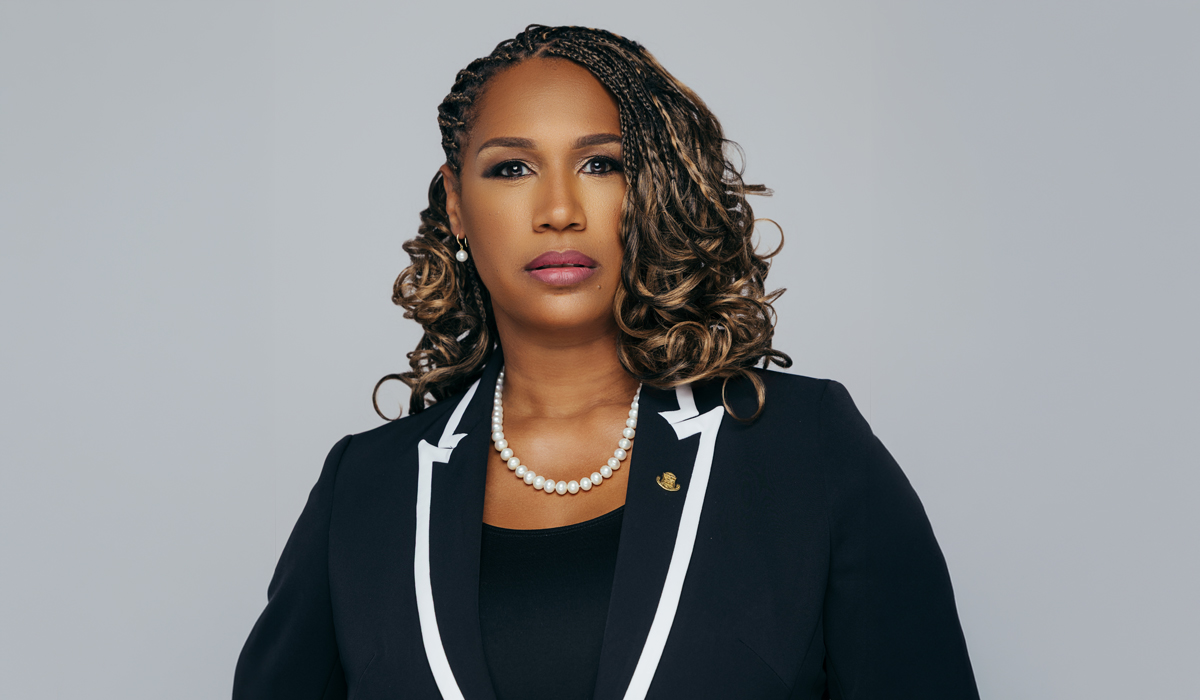
08 Jul Interview with Grisha Heyliger-Marten, Minister of Tourism, Economic Affairs, Transport and Telecommunication, Deputy Prime Minister, Sint Maarten
Sint Maarten’s economy remains one of strongest economies in the Caribbean, supported by its dynamic tourism industry, strategic geography between the Americas and close economic ties with the United States. How does Sint Maarten distinguish itself as both a regional economic leader and cultural hub within the Caribbean?
Saint Martin is one of the most unique islands in the Caribbean. We have two airports, two sovereign flags — France and the Netherlands — and pride ourselves as a true Caribbean melting pot. On the Dutch side, just 16 of the island’s 37 square miles, we have 120 nationalities. What makes Sint Maarten special is the mix of European influence and Caribbean culture. Visitors enjoy Michelin-style cuisine, especially on the French side and vibrant nightlife on the Dutch side. Within minutes by boat, you can explore Anguilla or return to Sint Maarten — there is never enough time in just one week. That is why so many people have made Sint Maarten their home.
We are a young country. Only 15 years ago, Sint Maarten became autonomous, previously part of the Netherlands Antilles. We are still building our institutions and adapting Dutch laws to our own systems, learning and growing as a nation. We implemented electoral reforms that, in my view, haven’t served us well, contributing to instability over the past 15 years. The new government understands the public’s frustration with elections every two years. While the previous administration barely completed its term, this one aims to serve a full four years, with reforms in place.
We moved from a monistic system — where commissioners also served on the island council — to a dualistic one, separating legislative and executive powers. Now we have 15 members of parliament and seven ministers, aligning with the principle of Trias Politica. It hasn’t been perfect, but this government, formed by four parties, is committed to real reforms and stability.
You’ve emphasized a proactive stance on fiscal reform. What steps is the government taking under the 2025 Financial Stability Plan to overcome inherited budget constraints and secure sustainable public financing?
One of our main priorities is sustainability. On the financial side, we are transitioning from direct to indirect taxation. In agriculture and food security, Sint Maarten has lagged for years. My department is establishing the Agriculture, Livestock & Fisheries Agency (ALF) to support farmers, fishers and animal husbandry. The agency will help with packaging, import-export and promoting local products — encouraging ‘buy local’ initiatives. This is expected by mid to late next year and will include modern agritourism, like farm-to-table experiences.
We are also creating a new cannabis industry as a sustainable economic pillar. The cannabis law is finalized and should pass by Q2 next year, with ALF overseeing its rollout. This will be a major business attraction for Sint Maarten.
Tourism accounts for over 90% of Sint Maarten’s GDP. Despite its population of just 40,000, the island welcomes around 1.4 million cruise visitors annually, with around half from North America. What factors are driving the recent surge in visitor arrivals and how is this growth benefiting local communities and small businesses?
Tourism supports hotels, taxis, tour operators and retail. Sint Maarten offers both European-style shopping on the French side and American-style shopping on the Dutch side. Our port is expanding to handle larger ships, allowing three to four at a time, which many Caribbean ports cannot accommodate. Facilities like A.C. Wathey Cruise and Cargo make us a leader in the region, boosting business for the local service community and creating new opportunities.
We are redefining luxury hospitality in Sint Maarten, focusing on boutique hotels and upscale tourism. In addition to Planet Hollywood we have a few boutique hotels and 5-star hotels slated to break ground in 2026. We are upgrading infrastructure and targeting high-end travelers, maintaining U.S. and Canadian markets while increasing focus on South America, Europe, Australia and possibly Africa.
The Dutch side has about 2,000 hotel rooms and 3,000 Airbnbs; the French side has 5,000 villas. Next year, we will ensure Airbnb taxes are properly collected and establish the Sint Maarten Tourism Authority to boost marketing and target luxury tourists. Our plans include island beautification, airport expansion and possibly U.S. preclearance, all aimed at attracting upscale visitors.
After seven years, we rebuilt our airport following the 2017 hurricane. It is beautiful but still too small, so the next phase is expansion. This will allow us to target more visitors and boost activity during the traditional slow season from May to September. Hotels typically run at around 60% occupancy in these months, but last year we had one of our best slow seasons. Our goal is to attract new audiences, shift marketing efforts to summer markets and create year-round sustainability for Sint Maarten tourism.
With its pro-business environment, lack of capital-gains tax and location bridging the U.S. and Latin America, Sint Maarten is positioning itself as a hub for trade, tourism and investment. How is Sint Maarten working with its Caribbean partners to strengthen regional collaboration in tourism, trade and sustainability?
I am holding introductory meetings with neighboring islands — Barbados, Bahamas, Jamaica — but trade will only start once the ALF Agency is established. Its main role will be to support farmers and manage trade. Our priority is food security: protecting local producers, assessing what we can grow and importing regionally.
Our priority is fiscal reform. Currently, businesses face a 5% transient occupancy tax (a tax on short term lodgings), 30–40% wage tax, and 34.5% profit tax, which is unsustainably high. At present, we can only offer a 10-year tax holiday to hotel developers. So we need urgent reforms to reduce or eliminate these burdens and start attracting diverse investors. Once that is in place, we can focus on innovation and FinTech. As well, once these reforms are passed, we plan to launch an Innovation Investment Promotion Agency. Currently, tourism and cannabis offer the best investment potential.
What is your final message to the readers of the Los Angeles Times?
If you come to Saint Martin, you will fall in love with the island. We are a melting pot with a unique mix of European and Caribbean culture. Our food, people and atmosphere are unlike anywhere else, and that will entice you to do business here or with us. With Dutch and U.S. treaties, it is especially easy for American investors to do business here — we welcome you to the friendly island.
Sorry, the comment form is closed at this time.