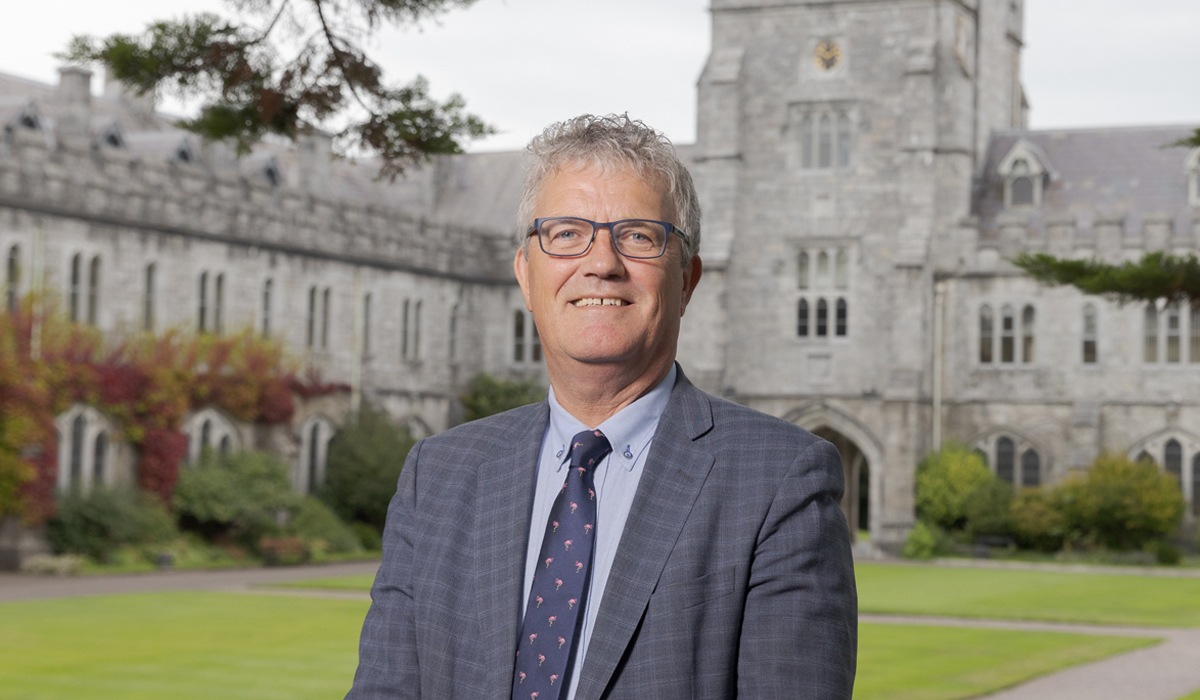
18 Oct Interview with John O’Halloran, President University College Cork (UCC), Ireland
Ireland’s tertiary sector punches above its weight globally, with all Irish universities appearing among the world’s top 800 institutions in the QS World University Rankings for the first time in 2025. In December, the government allocated €4.5 billion to higher education and research under the Tertiary Sectoral Plan 2026-2030. What factors have helped Ireland build one of Europe’s most respected higher education systems and where does the country stand out internationally?
Ireland has over 250,000 students in higher education, which is a significant proportion of our 5.3 million population, and that number continues to grow. We have seven research-intensive universities, including University College Cork, alongside five technological universities. International students represent 16% of our student population and that figure has also been increasing. Our most popular programs are business, followed by medicine and health and engineering and manufacturing. Ireland also ranks third in the OECD for the proportion of people attaining third-level education, with 66% compared with the OECD average of 48%. This reflects the importance Ireland places on education, with 57% of 18- to 24-year-olds in education, above the OECD average of 54%.
The Irish government has recently committed €460 million to a new national research network called Rinn, which will include seven research centers operating over the next eight years. University College Cork will receive a significant amount of that investment. This investment is a welcome step forward for Ireland’s research and innovation ecosystem, creating opportunities to develop talent, strengthen industry engagement and deliver impact nationally and internationally. It builds on the €750 million INSPIRE program announced last November for research infrastructure across Ireland’s higher education sector.
Ireland’s Impact 2030 strategy aims to raise research and development investment to at least 2.5% of the domestic economy by 2030. What role do universities play in achieving these goals and how are they positioning themselves as central hubs for moving research from the lab into industry?
Fundamental research is absolutely critical. Our first professor of mathematics at University College Cork was George Boole, who developed Boolean logic in the 1800s. It became the foundation of modern technology, although its full impact only emerged decades later when Claude Shannon at MIT recognized its potential. More recently, George Boole’s great-great-grandson, Geoffrey Hinton, received a Nobel Prize for his work on AI. The path from discovery to industry varies. Some breakthroughs require decades before their value is fully realized, while others create opportunities much sooner. NeuroBell, a medical device company from our university, illustrates this shorter pathway. It developed portable EEG monitoring technology to detect seizures in young babies at the bedside, bringing university research into a healthcare setting in less than a decade.
University College Cork is a globally ranked, research-led institution and one of Ireland’s leading universities. Can you give readers of the LA Times an overview of UCC’s evolution over its 180-year history and the values that continue to define the university today?
University College Cork is a comprehensive university located in the Munster region of southern Ireland and the largest research-intensive university in the area. Our identity is centered around sustainability and inclusion. We are ranked 220th in the 2027 QS World University Rankings and second in the world for sustainability in the UI GreenMetric World University Rankings in 2025. We also have four subjects ranked among the top 50 globally by QS. For U.S. readers, a particular distinction is that we are the only university in Europe to receive a platinum award through the U.S.-developed STARS sustainability framework.
Founded in 1845 and with just 115 students enrolled in its first year, today, UCC has close to 27,000 students, including more than 5,500 international students. In 1885, UCC was among the first universities in Europe to admit female students and this progressive spirit continues today in our multi-cultural student community who come from very diverse backgrounds and from more than 140 countries. As a public university, we believe our student population should reflect society, which is why we have developed a range of nontraditional pathways to ensure access and meet societal needs. Around 24% of our undergraduate students enter through alternative pathways. Beyond our academic mission, the university generates €1.2 billion annually for the economy – a sixfold return on state investment – and supports one in 13 jobs in the region. We graduate more than 7,500 students each year, with 95% in employment or further education within nine months.
In March, UCC published its five-year Capital Development Plan, with more than €350 million earmarked for investment. How will these projects transform teaching, research and student life in the years ahead?
Like many universities after COVID-19, we have reassessed what creates a strong student environment. Our investment plan focuses on both physical infrastructure and digital capability. New facilities will strengthen teaching and research and expand flexible learning. A major focus is the Tyndall National Institute, Ireland’s largest research institute, where we are doubling capacity to cement Ireland’s place at the heart of Europe’s semiconductor and deep-tech future. We are also developing a new building for our triple accredited Cork University Business School focused on innovation, particularly in food business, and expanding our medical school capacity in partnership with the Health Service Executive.
How is UCC expanding lifelong learning opportunities and supporting Ireland’s growing focus on apprenticeships and flexible education pathways?
As a 180-year-old university, we recognize that becoming more responsive in new areas can sometimes take time, but I am very pleased with how agile we have been in this space. We are expanding apprenticeships and creating more flexible ways for people to combine work with education. In a first for Ireland, we recently graduated 100 social workers through an apprenticeship model that allows participants to remain in the workforce while gaining qualifications. We have also launched a new paramedicine apprenticeship to help address identified skills shortages. We are offering more micro-credentials and the skills academies we have developed across sustainability, AI and semiconductors are critical to this effort. The aim is to provide both credited and non-credited learning, bringing education into the workplace.
Universities are increasingly acting as engines of economic and community development, helping create new businesses, build future talent and promote inclusion. At UCC, programs such as IGNITE continue to support founders from concept to launch, with the latest call providing more than €20,000 in funding and support. How has UCC established itself as a launchpad for startups and entrepreneurs and which emerging ventures should we be watching?
As part of our strategic plan, Securing Our Future, launched just over 2.5 years ago, we set out an ambition to become an innovation campus – one that encourages entrepreneurship across the entire university, not only among business students. We have developed several programs to advance this goal and to work with entrepreneurs to launch start-up companies based on UCC research.
GatewayUCC supports researcher-led startups and spin-out companies, which have created more than 450 jobs over the past decade. IGNITE, Ireland’s leading full-time, in-person startup program for recent graduates, supported 26 graduate-led companies last year, with 110 IGNITE-supported startups now active.
Universities across Ireland continue to face staffing challenges. How is UCC attracting, developing and retaining academic talent and what more is needed to future-proof the sector?
Attracting talent has not been a major issue for us. Student demand is stronger than ever, with significant growth in first-preference Irish applications and international enrolments. We believe that talent is drawn to areas where there is expertise and critical mass. By developing strengths in fields such as semiconductors, food, microbiome and health, sustainability, pharmacy and future medicine, we create an environment where our students are taught and mentored by leading researchers. Our success in the global talent program, where UCC secured 6 of the 20 available places across Irish universities, is a good example. We are confident in our ability to continue attracting talent by remaining focused and not becoming complacent.
Digital transformation and sustainability are reshaping higher education. Under its Capital Development Plan, UCC intends to invest more than €30 million in digital infrastructure. As technology literacy becomes increasingly important, how is UCC adapting its curricula to prepare graduates for the future world of work?
There are two parts to our digital investment. The first is improving the university’s operations, ensuring our processes are agile and effective. The second is enhancing learning through virtual environments, AI and other digital tools. A key part of our learning model is our Connected Curriculum, which ensures that important themes are intentionally embedded across our taught programs. This curriculum approach emphasises the holistic development of students through research-based, collaborative enquiry and embraces diversity and lifelong learning to connect teaching with workplace engagement. Research is central to this, with students exposed to leading experts in areas such as AI and digital technologies. Employability is also a core focus, alongside sustainability – 72% of our undergraduate programs and more than 60% of our postgraduate programs include an intentional sustainability focus.
We place strong emphasis on interdisciplinary learning because the world’s challenges cannot be solved by individual disciplines alone. Our curriculum has a global outlook and connects the university with society and industry and our 95% graduate employment or further education rate gives us a strong indication that this approach is delivering.
How is UCC balancing innovation with responsible implementation?
All universities are navigating this space, but our approach is to ensure that AI’s potential is realized responsibly across operations, research and teaching. On the operational side, we make sure that the software we use complies with legal and regulatory requirements. In research, AI is both a field of study and a tool for creating new opportunities. Our cutting-edge AI research, led by Professor Barry O’Sullivan, focuses on responsible AI, including governance and control measures. We are exploring applications such as using AI tools to reimagine drug development, including research funded by the Gates Foundation under Professor Brendan Griffin.
In teaching, the focus is on maintaining academic integrity while helping students develop the skills to use AI effectively and critically. Through our Graduate Attributes program, we have emphasized the importance of digital fluency, which now includes AI literacy and provided bespoke support for students to develop appropriate skills.
How has sustainability become embedded across UCC’s operations, research and curriculum and what factors have helped the university become a global leader in the UI GreenMetric World University Rankings?
We are very proud of our sustainability leadership, but it did not happen overnight. It has been many decades in the making, beginning not with university leadership, but with our students. From the outset, UCC’s sustainability journey has been student-led, research-informed and practice-focused. What has been critical to this success is bringing our academic community and operations teams together. Our research informs how the university is run, ensuring our values are reflected in practice. Across our operations, this includes procurement, water and energy management and reducing our carbon footprint.
In teaching and research, we have aligned our work with the UN Sustainable Development Goals, with academic leaders driving this work across the institution. Our students continue to push us forward. They led the move to eliminate single-use plastics on campus more than five years ago and UCC became the first Irish university to gain official observer status at the UN Climate Change Conference.
UCC’s institutional transformation was inspired by students, enabled by leadership and delivered by the university community. In 2007, the UCC Green Campus Committee was established by students, which led to very early recognition as the first Green Flag university in the world and ISO 50001 certification in 2010. These early bottom-up initiatives were met with a top-down strategic prioritization resulting in transformational change across the whole institution and continued awards and recognition including Green Gown Global Sustainability Institution of the Year in 2023 and second most sustainability university in the world in UI GreenMetric 2025.
Ireland’s higher education sector remains strongly outward-looking, with record international enrollments in 2025 led by students from India and the USA. Last year, UCC launched its Global Engagement Plan to further expand its international reach, with students from more than 100 countries now represented on campus. How has UCC benefited from record international enrollments and what is the university doing to raise its profile in key markets such as the USA?
International engagement is a very important part of who we are. UCC is home to students from around 140 nationalities, including more than 5,500 international students. That diversity brings enormous richness in culture, ideas and perspectives. To expand our global presence, in 2023 we appointed a vice president for global engagement, Professor Ursula Kilkelly. Her role is to position UCC as a global university by growing our international community while promoting the values that define us, including sustainability, inclusion and belonging.
The United States is our second-largest international student market after China. Beyond student recruitment, we have around 1,500 research collaborations with US institutions across a wide range of fields, resulting in almost 8,000 co-authored publications over the past 5 years.
In March, UCC and the University of San Francisco signed a strategic partnership agreement. How are collaborations such as this helping strengthen UCC’s teaching and research capabilities, particularly with US institutions?
These partnerships are critically important because they are fundamentally about talent – universities depend on talented students and faculty. The US has one of the world’s most dynamic innovation ecosystems, while strong industry links between our countries enable the movement of people, knowledge and ideas. With many leading technology and pharmaceutical companies located close to UCC, these connections are especially valuable. More broadly, US investment in Ireland has created jobs and increased demand for quality education at every level, benefiting communities on both sides of the Atlantic.
Why should US students choose UCC and what makes the student experience unique?
Ireland is a safe place with a warm, welcoming culture. It is small but globally connected, with universities that produce highly employable graduates and research closely linked to strategic industries. Since Brexit, Ireland has become the EU’s only large native English-speaking country in higher education, which is a significant advantage for international students, researchers and global talent.
Our ambition is to secure the future – for our students, our communities and our planet. For our students, that means providing the best research-led education possible and helping them become the best versions of themselves, developing as engaged citizens who understand the importance of democracy. For our communities, it is creating a stronger sense of belonging and advancing equality in all its forms. For the planet, our responsibility is to address pressing issues such as the climate crisis and its effects on migration, human health and society. Our goal is to make our knowledge and our people available to help tackle these global challenges. Come to Ireland, immerse yourself in our culture, our society and our talent. You will never forget the experience – and we will never forget you.
Sorry, the comment form is closed at this time.