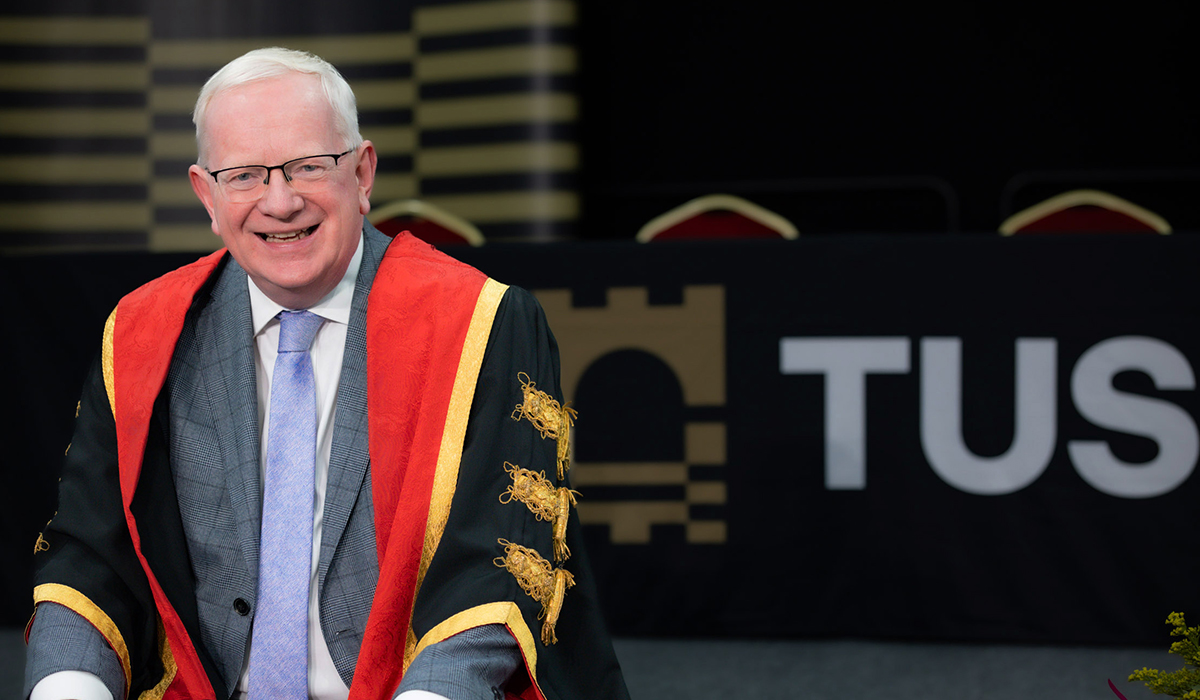
18 Oct Interview with Vincent Cunnane, President Technological University of the Shannon (TUS), Ireland
Ireland’s tertiary education sector punches above its weight globally, with all Irish universities appearing among the world’s top 800 institutions in the QS World University Rankings for the first time in 2025. In December, the government allocated €4.5 billion to higher education and research under the Tertiary Sectoral Plan 2026–2030. What factors have helped Ireland build one of Europe’s most respected higher education systems and where does the country stand out internationally?
Ireland has never had abundant natural resources like coal or minerals. Instead, our greatest resource has always been our people. A series of smart policy decisions, especially in education, helped unlock that potential. A turning point came in the late 1960s when Minister for Education Donogh O’Malley introduced free secondary education. It transformed the country by giving thousands of young people access to education who otherwise would never have had the opportunity. As more students completed secondary school, the need for further and higher education grew. While Ireland already had established universities such as Trinity College Dublin, University College Cork and University College Dublin, the country needed a broader, more regional system. That led to the creation of Regional Technical Colleges across Ireland’s major towns. They played a crucial role in developing the skilled workforce needed to support the country’s growing foreign direct investment and industrial development.
We may have initially attracted companies because of Ireland’s low corporate tax rate and initiatives such as the Shannon Free Zone, which played a transformative role in this region. But attracting investment was only part of the story — we also needed the talent to support it, particularly skilled technicians for manufacturing. That drove the evolution of the regional technical colleges into Institutes of Technology, which expanded from technician training to offering bachelor’s degrees in engineering, science and the humanities. Over the past five years, that evolution has continued with the creation of technological universities. As president of one of them, I am proud of the role they play. They complement Ireland’s traditional universities but, crucially, they are regionally based. They develop talent across the country, helping attract and retain foreign direct investment — not only in the major cities but throughout the regions. This regional model has opened higher education to many people who might never have attended university because they couldn’t afford to move away from home.
Today, they can study at internationally recognized technological universities close to where they live, gain the skills employers need and build careers in their own communities. Ultimately, it all comes back to talent. Ireland has always placed a high value on education and today that extends from apprenticeships to master’s degrees, PhDs and world-class research, delivered right across the country.
Ireland’s Impact 2030 strategy aims to raise research and development investment to at least 2.5% of the domestic economy by 2030. What role do universities play in achieving these goals and how are they positioning themselves as central hubs for moving research from the lab into industry?
Technological universities are central to innovation because they sit close to industry and help translate research into new products and processes. At TUS, we work across the full RDI spectrum, from fundamental research through development to innovation. In Europe, this is often described using Technology Readiness Levels (TRLs) from 0 to 10. Traditional universities typically focus on TRL 0–5, while technological universities operate mainly in TRL 4–9, bridging the gap to industry, which leads at the highest levels. Through programs such as Research Ireland’s new RIN centres, we are increasingly involved in industry-linked, problem-solving research. Overall, technological universities have evolved from teaching-focused institutes into research-intensive institutions that better support national needs and industry innovation.
Since its establishment in 2021, Technological University of the Shannon has grown into a major regional center for education, research and innovation, serving more than 15,000 students and employing over 1,500 staff across seven campuses. TUS is one of Ireland’s five technological universities and plays a key role in supporting regional development and skills creation. Can you give an overview of TUS’s evolution since its establishment in 2021 and the values that continue to define the university today?
TUS was established in October 2021 through the merger of Limerick Institute of Technology and Athlone Institute of Technology, creating a university that serves both the Midlands and Midwest of Ireland. Today, we have more than 16,500 students, around 2,000 staff, over 400 PhD researchers and approximately 1,500 international students. One of our greatest strengths is our close partnership with industry. Employers are actively involved in designing, developing and reviewing our programs, ensuring our graduates have the skills businesses need. This strong collaboration is a key differentiator for TUS and for technological universities in Ireland. As a result, TUS has achieved the highest graduate employability rate in Ireland for three consecutive years. That’s the strongest evidence that we’re producing industry-ready graduates who are in demand by employers at the local, regional and national levels.
I previously served as president within a European University Alliance, an initiative inspired by President Macron’s vision that European universities should collaborate to compete globally with institutions in North America and Asia. At TUS, we coordinate the Regional University Network – European University, a €14.5 million project, and until recently I chaired an alliance representing around 120,000 students and 20,000 staff. Although TUS is a young university, it has performed strongly and holds a QS Five-Star rating, which strengthens our international profile and student recruitment.
A key part of our mission is widening access. We believe talent is evenly distributed, but opportunity is not, so we provide pathways for students from all backgrounds. Many come through access programs, progress to postgraduate and PhD level and successfully enter employment. Overall, our focus remains on serving our regions and stakeholders while maintaining our position as Ireland’s leading university for graduate employability.
How has TUS delivered on its inaugural Strategic Plan which concludes in 2026 and what major developments are planned to further modernize and expand its campuses?
Our last strategic plan was developed before the AI revolution, but AI has since become a major focus. As we prepare our next strategy, it will be central to how we evolve as an institution. We aim to produce graduates with strong technical knowledge alongside essential soft skills such as critical thinking, communication, writing and teamwork, while also ensuring they are AI and digitally literate.
Recently, we have begun embedding AI across all modules and updating assessment methods in response to its impact on teaching and learning. At first, AI was disruptive, particularly for assessment and examinations. We have now moved into a phase where we are focused on using AI positively in teaching, learning and research and embedding it institution-wide. While AI will transform the nature of some graduate roles, our view is clear: graduates who are AI-ready will always have a stronger advantage in the labor market. We continue to review and future-proof our programs every five years, ensuring strong applied research links across Europe and beyond, while maintaining our core focus on employability.
TUS recently launched two new apprenticeship programs in technology and engineering. How is the university expanding lifelong learning opportunities and supporting Ireland’s growing focus on apprenticeships and flexible education pathways?
Apprenticeships are a major part of what we do at TUS, alongside our undergraduate, master’s and PhD programs. We currently support over 2,000 apprentices across fields such as electrical, plumbing and mechanical trades, working closely with the further education and industry sectors. A growing area is consortium or industry-led apprenticeships, where employers identify skills gaps and design programs around them. In these models, apprentices are employed by industry from day one, typically starting as 18-year-olds, and they combine on-the-job training with periods of study at TUS and further education partners. These apprenticeships now span areas such as accountancy, insurance, advanced electrical work, road testing and software testing. TUS is at the forefront of this development, helping to address skills gaps and ensuring apprenticeships are valued alongside traditional bachelor’s and master’s degrees. Lifelong learning is a key priority for us. Post-COVID, we made a clear distinction in our delivery model: our undergraduate programs are fully face-to-face, as we believe 18-year-old students benefit most from on-campus learning, where they develop both technical and soft skills. In contrast, our lifelong learning provision is delivered 100% online. This allows working professionals to upskill without returning to campus, through flexible programs ranging from short courses to fully online master’s degrees. Each year, around 2,000 learners engage with these programs. Overall, we see our role as supporting both talent development and talent retention, helping individuals and employers continuously upgrade skills throughout their careers.
Universities are increasingly acting as engines of economic and community development, helping create new businesses, develop talent and promote inclusion. TUS works closely with initiatives such as Enterprise Ireland’s New Frontiers Programme to support entrepreneurship and innovation across the region. How has TUS established itself as a launchpad for startups and entrepreneurs and which emerging ventures should we be watching?
Enterprise and innovation are a key part of our work, closely linked to our research activity. We support both spin-outs and spin-ins, helping startups in their early stages through structured programs. In partnership with Enterprise Ireland, we deliver the New Frontiers Programme across the Midlands and Midwest, supporting around 12 new companies each year. It helps founders develop their ideas into viable businesses, covering areas such as finance, marketing and business development, with strong mentorship and expert support. We have seen success across sectors including pharmaceuticals, orphan drugs, IT and increasingly AI-driven companies. After the programme, startups can continue to grow within our innovation centers until they are ready to scale independently as established businesses.
TUS supports more than 1,500 staff across its campuses. How is the university attracting, developing and retaining academic talent and what more is needed to future-proof the sector?
As an intellectually driven institution, it is essential that our staff are supported to perform at their best, stay motivated and remain at the forefront of their fields. This includes how we reward development and sustain engagement across the organization. We have a Centre for Continuous Professional Development that supports academic staff, particularly in areas such as AI, digitalization and academic integrity, which are increasingly important. We also provide ongoing upskilling opportunities across teaching and research.
On the research side, we actively support funding applications and provide dedicated structures to improve success rates. For professional staff, we offer development programs and further study opportunities. Many colleagues join us from industry and we support them in pursuing master’s and PhDs, with over 100 currently undertaking doctoral studies.
Digital transformation and sustainability are reshaping higher education. TUS is actively adopting new technologies to enhance teaching, strengthen research and equip students with the skills needed for future careers. As technology literacy becomes increasingly important, how is TUS adapting its curricula to prepare graduates for the future world of work?
This is critical to us. We focus on producing industry-ready graduates and today that means strong skills in AI and digitalization. We have updated our programs and modules to embed AI literacy across the curriculum. We work closely with industry through program boards, where employers help define the skills they need. We then adapt our programs accordingly, even in areas where the future direction is still evolving. The goal is to continuously future-proof our graduates so they are employable, adaptable and able to contribute to industry development as it changes.
The university recently received the Green Flag from An Taisce in recognition of excellence in environmental management. How are digital technologies changing teaching, learning and university operations and how is TUS balancing innovation with responsible implementation?
There are two main drivers of our sustainability agenda. The first is legislation — European and Irish regulations that require us to reduce carbon emissions, improve energy efficiency and transition to renewable energy sources. We are actively monitored against these targets. The second driver comes from our staff and students. They are highly aware of the long-term impact of climate change and want to see meaningful action. In response, we are embedding sustainability across all programs, as industry increasingly expects graduates with this awareness.
Much of our progress is staff and student-led. For example, our Green Flag initiatives were driven by staff and students working together, rather than top-down direction and we are proud to have achieved Green Flags across several campuses, including Thurles, Clonmel and Athlone, with others to follow. Ultimately, our approach combines policy and purpose — the “head and the heart” — from major institutional change to everyday actions like energy conservation across campus.
Ireland’s higher education sector remains strongly outward-looking, with record international enrolments in 2025 led by students from India and the USA. TUS recently received the TrustEd Ireland statutory quality mark, recognizing excellence in its international student experience. How has TUS benefited from record international enrolments and what is the university doing to raise its profile in key markets such as the USA?
We see significant potential in the U.S. market and summer schools will be our first step, building on the strong historical and cultural links between Ireland and the United States. We will launch our first summer schools next year. As a new university, international visibility is a challenge, so we pursued the QS rating system. We achieved a five-star rating across all assessed areas, which has been very valuable in attracting international students. This recognition has helped us recruit from key markets such as China, India, Malaysia, the Middle East, Nigeria, Kenya, Mexico and Canada. The U.S. remains an important target market for our next phase of international growth.
Why should U.S. students choose TUS and what makes the student experience unique? How are TUS’s international partnerships helping strengthen its teaching and research capabilities, particularly through collaboration with U.S. institutions?
Ireland’s cultural and historical links with the U.S., along with Shannon Airport’s direct connections and US pre-clearance, make the region highly accessible. You can travel from Shannon to cities like New York, Boston or Chicago as if it were a domestic journey. What makes TUS distinctive is our strong industry focus and high employability outcomes, delivered through close industry links and work-based learning, including extended placements in the third year. We also offer smaller class sizes, where lecturers know students personally and we are highly rated for staff–student interaction. Students learn in a diverse international environment across classrooms, labs and workshops. Combined with a high quality of life — close to the Atlantic, with safe communities and strong student support — TUS offers both an excellent academic and living experience.
You have led TUS since its establishment in 2021, guiding the university through its formation, integration and growth across various campuses. You recently stepped up as Interim Chair of the Technological University Association, while it was also announced that you will retire at the end of the year. As you prepare to conclude your time as president, what would you most like your legacy to be and where would you like to see TUS over the next five to ten years?
Ireland has a strong higher education system spanning traditional universities, technological universities and close links with industry. For TUS, our legacy is to remain true to our roots: strong industry engagement, highly employable graduates and a focus on applied research, with basic research emerging from that work. We are also committed to providing opportunity for all — supporting students from every background and helping them realize their potential.
Our ethos is inclusive and supportive: we don’t judge students when they arrive, but we support them to succeed by the time they graduate. Regionally, TUS has helped transform its locations into university towns, including Athlone, Thurles, Ennis and Clonmel, alongside Limerick’s two-university ecosystem. This strengthens local talent development and supports foreign direct investment by ensuring industry has access to skilled graduates. Ultimately, our goal is to continue producing the talent that enables global companies to succeed in Ireland and our regions.
What is your final message to LA Times readers?
Ireland is open for business, with the talent, policies and infrastructure to support a smooth transition from the U.S. West Coast to the west coast of Ireland. Companies that have made that move have consistently succeeded. We would encourage you to explore Ireland — you will find strong opportunities and a highly supportive environment for growth.
Sorry, the comment form is closed at this time.