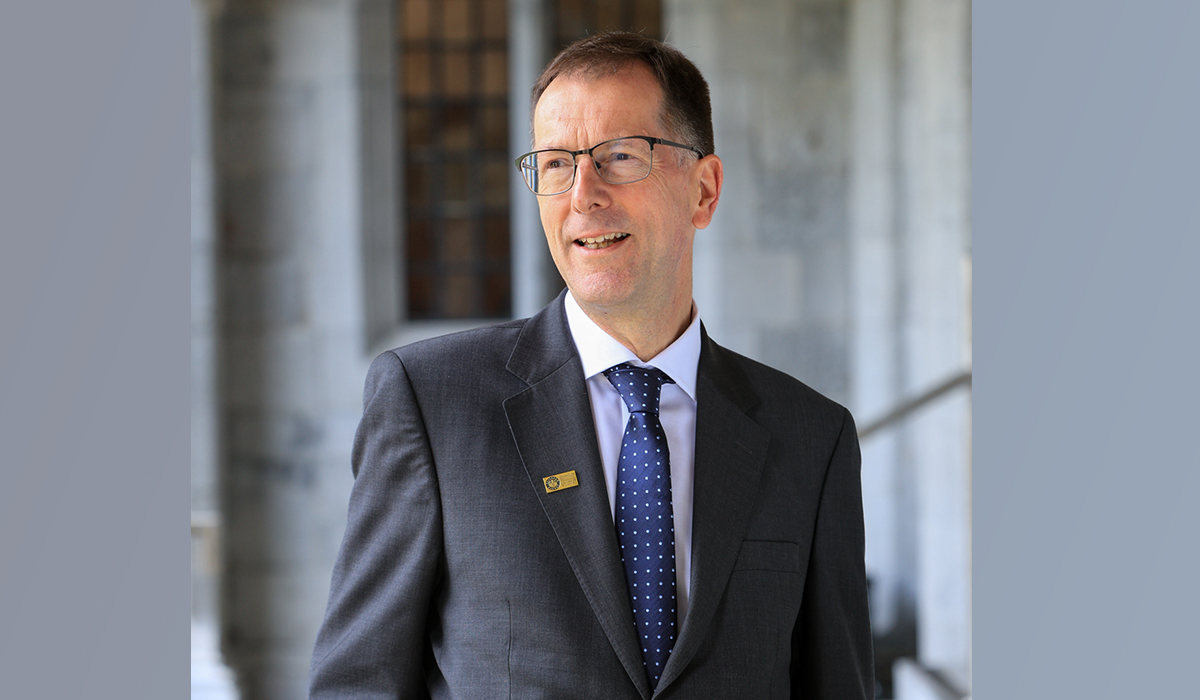
18 Oct Interview with David Burn, President, University of Galway, Ireland
Ireland’s tertiary sector punches above its weight globally, with all Irish universities appearing among the world’s top 800 institutions in the QS World University Rankings for the first time in 2025. In December, the government allocated €4.5 billion to higher education and research under the Tertiary Sectoral Plan 2026–2030. What factors have helped Ireland build one of Europe’s most respected higher education systems, and where does the country stand out internationally?
I’m not Irish by birth and only recently became President of the University of Galway, taking up the role in September last year. I previously worked at Newcastle University in northeast England, which gives me an interesting perspective for comparison. Ireland punches above its weight in higher education. University participation is among the highest in Europe and education is highly valued by families and society. Around 65% of people aged 25–34 hold a tertiary qualification, compared with the EU average of 44%. This success is built on a strong primary and secondary education system that prepares students well for university.
Ireland’s higher education sector is under less pressure than the UK. One advantage of Ireland’s size is that universities can be agile and highly collaborative, both with each other and with external partners. In Galway, we have particularly strong links with industry, our partner institution Atlantic Technological University and the thriving med-tech sector. Galway is one of the world’s leading med-tech hubs and that creates a powerful partnership between the university and industry, benefiting both sides.
Ireland’s Impact 2030 strategy aims to raise research and development investment to at least 2.5% of the domestic economy by 2030. What role do universities play in achieving these goals and how are they positioning themselves as central hubs for moving research from the lab into industry?
Universities are central to Ireland’s innovation ecosystem. We attract significant research and development funding and play a key role in turning research into economic impact. At the University of Galway, for example, we have launched 24 spin-out companies since 2020 and now support a portfolio of more than 35. We work closely with both growing local businesses and major multinationals such as Medtronic and Boston Scientific. These partnerships are valuable not only because our research helps drive innovation, but also because we provide highly skilled graduates. Industry leaders consistently tell us they are impressed by the quality of our graduates, many of whom build long-term careers in the Galway and northwest region. It’s a strong example of how investment in research, universities and industry creates lasting benefits for the economy.
The University of Galway was founded in 1845, during one of the most significant periods in Irish history, the Great Famine. In its early years, the university helped support people affected by the crisis and welcomed its first cohort of around 68 students in 1849. Since then, we have grown into a university of around 20,000 students, with approximately 20% of both our staff and students coming from international backgrounds. As a longstanding anchor institution in Galway, we have continually evolved while remaining committed to our core values of excellence, belonging, sustainability, openness and respect. Building on that foundation, our new strategic plan places an even stronger emphasis on the fundamentals of education and research, while continuing to serve our community and wider society.
Our research strategy is built around four pillars. First is health innovation, covering med tech, clinical trials and related fields. Second is sustainable and resilient environments, reflecting our Atlantic location and strong work on oceans, land and peatland restoration. We are also highly active in sustainability research and consistently rank among the leading institutions in this area in Europe. The third pillar is transformative data and artificial intelligence, including hosting Ireland’s national supercomputer, CASPlr. The fourth is culture, creativity and society, rooted in our bilingual identity as Ireland’s only bilingual university and our deep connection to Irish language, arts and culture, including immersive learning in Connemara. Together, these areas define our research impact and identity.
Lifelong learning is an area where all universities are expanding. We are developing a wide range of options, particularly online, to support people throughout their careers, not just during their initial degree. Apprenticeships are more strongly developed in the technological universities, but traditional universities like ours are also adapting. Our focus is on helping to develop the workforce and being as flexible and responsive as possible to changing needs.
Universities are increasingly acting as engines of economic development by creating new businesses, developing talent, and promoting inclusion. Through its Business Innovation Centre and wider innovation ecosystem, the University of Galway has helped launch a significant number of startups and spinout companies. How has the University of Galway established itself as a launchpad for startups and entrepreneurs and which emerging ventures should we be watching?
Since 2020, we have launched 24 companies and grown our spin-out portfolio to more than 35. This success is supported by initiatives such as BioInnovate, modeled on Stanford, and our research centers focused on medical devices, including the former CÚRAM Centre. These programs work closely with industry to develop real-world solutions, increasingly focused on areas such as aging and multi-morbidity. Alongside this, we are also expanding into creative technologies, linking our cultural strengths with new digital innovation.
The university employs around 2,500 staff. How is it attracting, developing and retaining academic talent and what more is needed to future-proof the sector?
Galway is highly attractive to academics, students and leaders alike. It is a beautiful city, surrounded by the landscapes of Connemara, Clare and the Burren, all easily accessible. Our research pillars are broad enough to include most of our research-active staff, which helps attract high-performing academics while also retaining strong internal talent. Many people choose to stay and build their careers here. We also benefit from international diversity, with around 20% of staff coming from abroad, contributing to a welcoming and inclusive environment. Overall, it is a distinctive and highly attractive place to live and work.
Under its current strategy, the University of Galway is investing heavily in digital technologies to enhance teaching, research and campus operations. How are digital technologies changing teaching, learning and university operations and how is the University of Galway adapting its curricula to prepare graduates for the future world of work?
We are all working to understand both the benefits and challenges of AI. On the one hand, it can improve efficiency in how universities use public funding. For students, there are two key dimensions: learning how to use AI responsibly and developing the wider skills employers need, such as critical thinking, teamwork and leadership. Universities must adapt their programs, including interdisciplinary courses that combine areas like business and AI. At the same time, AI is changing how we assess students and applications, which is becoming more complex. We need to adapt assessment methods, ensure appropriate use is declared and focus on evaluating skills that cannot be replicated by AI. This is a continuing process across all Irish universities.
We have four colleges, including Medicine, Nursing and Health Sciences. One of our most innovative developments is a new graduate-entry medicine program in rural and connected health. It will place students in regional academies across the northwest, including Sligo, Roscommon and Donegal, so they are trained in the communities where they may later practice. The aim is to use new technologies to keep them digitally connected while encouraging more graduates to remain in those areas and support local healthcare needs. This initiative has strong support from the Higher Education Authority in Ireland and is an exciting step forward in rural medical education.
Ireland’s higher education sector remains strongly outward-looking, with record international enrolments in 2025. The University of Galway is also a member of the ENLIGHT European University Alliance, strengthening its international teaching and research links. How has the University of Galway benefited from record international enrollments and what is it doing to raise its profile in key markets such as the USA?
Internationalization is central to our strategy. To be the best, you need to learn from the best and addressing global challenges requires strong international collaboration. Attracting students from diverse backgrounds enriches the student experience and builds cultural awareness that cannot be replicated otherwise. We strongly encourage this global outlook.
We are also seeing growing interest from the U.S. market. The University of Galway offers American students a safe, English-speaking city, a rich cultural experience and high-quality education at a more affordable cost than in the United States.
We have strong connections with the United States, including multinational partners such as Medtronic and university links with institutions like Notre Dame and Villanova, which send students to Galway for cultural and academic exchange. I have also met alumni in New York and plan to spend more time in the U.S. building relationships with alumni networks and academic, business and philanthropic partners to raise the university’s profile. We already have active alumni communities in places like Chicago and California and I want to strengthen those links further.
You became president of the University of Galway in September 2025 following a distinguished career that included serving as Pro-Vice-Chancellor of the Faculty of Medical Sciences at Newcastle University. What are your top priorities for the University of Galway today and where would you like to see the institution over the next five to ten years?
When I was interviewed for the role, I described a vision of getting into a taxi in New York with the chair of the governing authority after the university had broken into the QS top 200. It would be a moment of celebration, but also recognition that people immediately know the University of Galway and what it stands for, particularly our strengths in our four strategic pillars. In that same moment, I imagined being approached by an alumnus describing a great, personalized student experience, continued opportunities for lifelong learning and an invitation to act as an ambassador for the university. Ideally, that conversation would even be in Irish, reflecting the importance of our bilingual identity, to which I am personally committed as a non-native speaker. Overall, it reflects my aspiration for the university to be internationally recognized, distinctive and deeply connected to its roots.
What is your final message to LA Times readers?
The University of Galway is a jewel in Ireland’s higher education system. It is a traditional university in a unique setting, offering an excellent experience for both domestic and international students in a safe, welcoming city. We deliver strong research and education, but more importantly, we exist to serve society — regionally, nationally and internationally.
Sorry, the comment form is closed at this time.