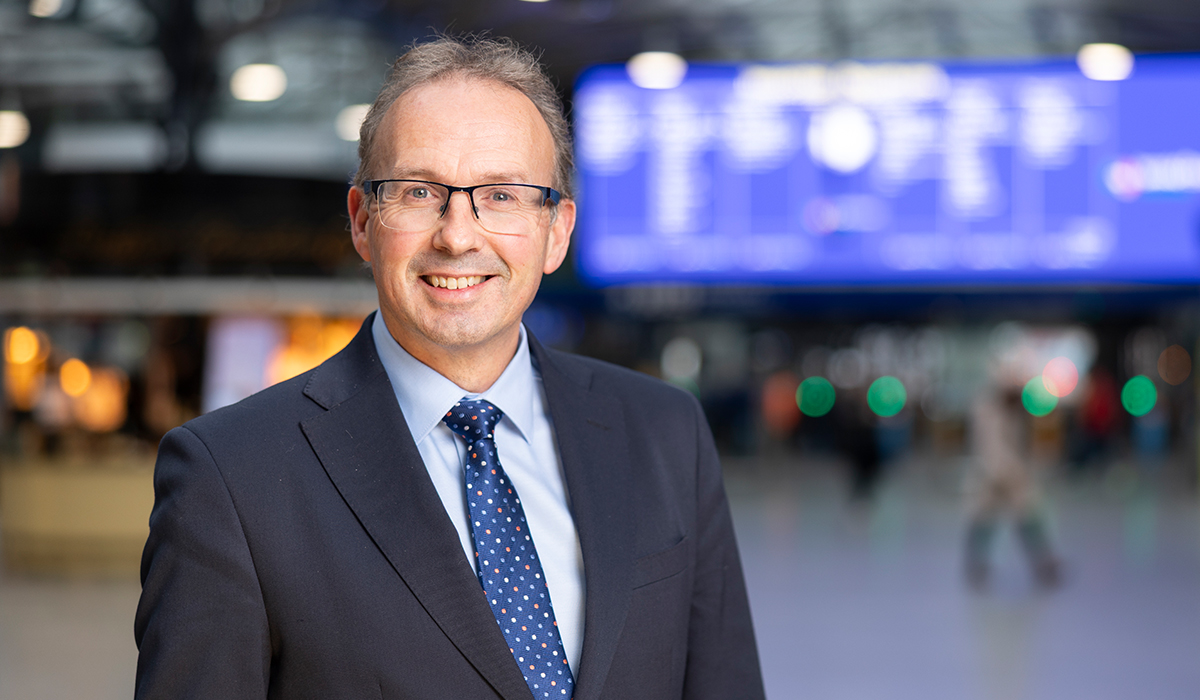
18 Oct Interview with Stephen Kent, CEO, CIÉ Group, Ireland
CIÉ is Ireland’s state-owned transport group, employing more than 13,000 people across Dublin Bus, Irish Rail, Bus Éireann, Rosslare Europort and CIÉ Tours. The group facilitates more than 300 million passenger journeys annually and generates approximately €1.8 billion in revenue. Can you introduce CIÉ Group to readers of the LA Times and explain its role in Ireland’s transport network?
CIÉ is a long-established organization made up of four companies, each delivering key transport services: Dublin Bus in Dublin, Iarnród Éireann (Irish Rail) operating the national rail network, Bus Éireann providing rural bus services and a tourism-focused bus company. Our operating companies delivered close to 336 million journeys last year, reflecting strong and growing demand for public transport.
Beyond focusing on reliable, large-scale customer service, CIÉ also acts as a mobility partner to the government. As a commercial semi-state organization, we work in partnership to deliver transport services that serve not only customers but also citizens more broadly. This includes supporting wider national priorities such as housing, sustainable development and reducing congestion. Through our national network of stations, depots and land assets, we contribute to transport-oriented development that can help enable new housing and community growth. In this way, CIÉ plays a wider role beyond transport delivery — supporting government policy and helping shape sustainable development across the country
.In March, the government launched two major transport strategies, Moving Together and the Sustainable Mobility Policy. How would you assess the strengths and performance of Ireland’s transport sector and how has it evolved into one of Europe’s leading mobility networks?
In recent years, particularly since COVID, we have seen strong and sustained growth in public transport use, with increases of around 20% year-on-year in the immediate post-COVID period and continued growth of between 4% and 12% in recent months. This reflects a broader shift toward public transport that we haven’t seen at this scale since the 19th century, when rail first transformed mobility. Today, that shift is driven by a combination of better services, significant government investment, lower fares and a strong focus on sustainability and quality of life.
Ireland’s transport strategy includes record investment of over €24 billion in public transport, aimed not only at supporting current demand, but also at building capacity for future growth. This is essential as we move toward a population of around 6 million and continue to see rising demand and congestion pressures. CIÉ is at the center of this transformation, helping to deliver and expand the network to meet both current needs and future growth.
CIÉ Group plays a central role in delivering Ireland’s expanding public transport network, including the DART+ program, BusConnects and the Connecting Ireland rural mobility plan. How is CIÉ Group aligning its strategy with national transport policies to improve connectivity and expand access to public transport?
We work closely with the National Transport Authority, which funds much of the public transport network, while CIÉ companies deliver services under that framework. Key programs such as DART+ and BusConnects are driving major expansion in cities like Dublin, Cork, Galway and Waterford, with service increases of up to 70%. This represents a significant step change in frequency, connectivity and accessibility across urban areas.
At the same time, we are transitioning to cleaner transport. This includes electrification of services in cities and the use of lower-emission fuels such as hydrotreated vegetable oil (HVO) for longer-distance routes, helping to reduce the environmental impact of public transport. Alongside this, the Ireland Rail Strategy to 2050 sets out a long-term vision for expanding rail capacity, improving frequency and even restoring some historic routes. We are also focused on connecting rural communities, supporting regional development, economic growth and social inclusion. All of this aligns with Ireland’s national Climate Action Plan and broader government objectives.
Since taking over as CEO, you have outlined a citizen-focused vision for CIÉ Group. You have highlighted priorities including addressing pension liabilities, increasing commercial revenues and unlocking the value of underutilized property assets. How can CIÉ Group use its land portfolio to create value for citizens while generating new revenue streams and what key developments are currently being planned?
There are three main strands to developing CIÉ for the public good: exchequer-funded public services, commercially operated services within the group and the strategic use of our assets to support wider national objectives. Much of our public transport network is funded through the National Transport Authority, but we also operate commercial services such as CIÉ Tours, Expressway within Bus Éireann, Dublin Tours and Rosslare Europort. Alongside this, a key opportunity is unlocking the value of our property and land assets, many of which are in prime transport locations. Some are underutilized and we are working to develop them for retail, community use and much-needed housing.
In collaboration with the government and the Land Development Agency, we see real potential to support housing delivery and regeneration while strengthening public transport. This integrated approach helps address housing, connectivity and congestion challenges, while continuing to serve the transport needs of the country. There are ongoing commercial opportunities across the CIÉ network, particularly in major stations such as Heuston, which serves around 7 million passengers annually. These include retail, advertising and other customer-focused services that help generate additional revenue for reinvestment into our infrastructure.
As demand grows, we need to invest in new stations, depots and upgraded facilities. This includes improving accessibility, modernizing buildings and adapting infrastructure to meet climate requirements, alongside upgrading the fleet. All of this requires sustained funding and development, but the goal remains the same: to improve the customer experience and keep customers at the center of everything we do.
Under Ireland’s Climate Action Plan, the transport sector is tasked with reducing emissions to 6 million tons of carbon dioxide equivalent by 2030 and reaching net zero by 2050. CIÉ Group’s latest Sustainability Annual Review reported over 8.5% reduction in emissions intensity per mile traveled since 2019. What major progress has CIÉ Group made in reducing emissions and introducing cleaner technologies across its transport services?
We have ambitious emissions targets and while we may not meet every milestone exactly on time, we remain firmly focused on achieving them. We are already transitioning city and town bus services to zero-emission vehicles, with full electrification achieved in places like Athlone, where the entire fleet has been converted. This has required significant investment in new depots and power infrastructure and serves as a model for further rollout in other cities.
Alongside electrification, we are trialing alternative fuels such as HVO and biofuels for longer-distance routes where battery electric solutions are less practical at present. We are also testing emerging technologies like hydrogen to ensure we are prepared as the wider national energy strategy develops. At the same time, we are upgrading our buildings to near zero-emission standards, ensuring that infrastructure improvements align with our overall climate goals.
This transition requires a combination of skills, capacity and technology. We are upskilling staff to manage high-voltage systems, while also adapting our procurement processes, which have traditionally focused on diesel, to new technologies and fuels. We are working to secure reliable supplies of alternatives such as HVO and biofuels, while also collaborating with manufacturers to ensure vehicles meet evolving requirements. This is relatively well advanced in city services, but more challenging for long-distance routes where electric solutions are not yet fully practical. We continue to explore alternative fuels and new technologies, including through partnerships and trials, while also supporting targeted grant schemes that help accelerate fleet renewal.
A key challenge is balancing asset life with the pace of transition, as vehicles are typically used for around 12 years or more. Without incentives, there is a natural tendency to extend their use, which can slow decarbonization. Overall, success depends on reskilling, procurement innovation, access to funding and close collaboration across industry and government to support a faster transition to lower-emission transport.
Ireland’s National Development Plan places a strong emphasis on skills development, innovation and regional growth. As Ireland expands its transport infrastructure, building talent and supporting local enterprise have become increasingly important priorities. What sort of talent and expertise has Ireland built across the transport sector and how is CIÉ Group helping develop a future-ready workforce?
In recent years, recruitment has been a major challenge in Ireland, particularly following COVID. We now need thousands of additional drivers — not only to replace those retiring or leaving, but also to support service expansion. We are working closely with the government on workforce taskforces to address skills shortages, especially for drivers and mechanics and we are expanding apprenticeship and training programs to build long-term capacity.
A key focus is improving diversity in the workforce. Within CIÉ, women currently make up around 11–12% of employees, up from about 5% previously, and our ambition is to reach at least 20% and continue improving from there. We are also working to make roles more attractive through better working conditions, training and career development. At the same time, customer-facing staff are being trained in new technologies and ticketing systems, while across the organization we are reskilling for a more digital and data-driven environment. We are increasingly using data and AI to improve timetables, scheduling, predictive maintenance and financial processes, helping us deliver services more efficiently and reliably. Overall, CIÉ is undergoing a broad transformation — focused on reskilling, inclusion and technology — to better reflect the communities we serve and improve performance across the organization.
How important is supporting SMEs and local suppliers in delivering Ireland’s transport ambitions and how does CIÉ Group help create opportunities for these businesses?
CIÉ enjoys very strong brand recognition, at around 98–99% across the country and we work closely with a wide network of local suppliers. For example, Bus Éireann contracts nearly 9,000 small operators to deliver Ireland’s school transport service, safely carrying over 180,000 children to school every morning, often in rural and remote areas. This is a major example of how we support local communities and small businesses across the country.
We also combine local and international sourcing, particularly for specialist systems such as rail safety technology, while delivering and operating much of the training and implementation in-house. Overall, our operations create a strong local economic multiplier effect — through direct employment, supplier spend and ongoing investment in the communities we serve.
In 2025, the government launched a new national tourism policy aimed at increasing overseas tourism revenues by 50% over the next five years through investment and pro-enterprise reforms. CIÉ Tours is the largest carrier of U.S. visitors to Ireland and recently received Gold Certification from Ireland’s Sustainable Tourism Network. How has rising tourism benefited CIÉ Tours and how is the company helping showcase Ireland as a world-class destination for international visitors, particularly in the USA?
We are currently the largest coach operator bringing visitors from the U.S. to Ireland. Significant work is done on the ground in North America to develop and promote these tours, particularly in a complex geopolitical and travel environment. Our focus is on showcasing Ireland’s landscapes, heritage and culture, while also evolving our products. While Ireland remains central, we are increasingly offering combined itineraries that can also include destinations such as Scotland or Spain, depending on customer demand. We also offer a range of travel styles, from coach tours to private, bespoke limousine experiences. Last year, we welcomed over 35,000 visitors, with a customer satisfaction rate consistently above 95%.
These guests experience tailored itineraries across Ireland, including destinations such as Dublin, Killarney, Cork, the Cliffs of Moher, Galway and Belfast, along with cultural experiences such as music, heritage sites and traditional events. This combination of experience, quality and authenticity is why CIÉ Tours continues to be a leading operator in the market.
Ireland is known for its “Céad Míle Fáilte” — a hundred thousand welcomes — which still defines the visitor experience today. Irish culture remains central to our tourism offering, with a strong tradition of language, music, dance and heritage. Our history, reflected in castles and medieval sites, offers experiences that are less common in many other destinations and continue to be a strong draw for visitors. At the same time, Ireland is a modern, evolving country. The quality of hotels, transport and visitor infrastructure continues to improve, supporting a consistently high standard of experience. This combination of rich culture and modern services is what makes Ireland distinctive and ensures a strong overall visitor experience.
You became CEO of CIÉ Group in January and have already outlined an ambitious program of reform to future-proof the organization. Before joining CIÉ Group, you successfully led Bus Éireann through the pandemic, network expansion and fleet modernization. What are your top priorities for CIÉ Group today and where would you like to see the organization over the next five to ten years?
For CIÉ, there are three key priorities. First is delivery. As a government partner, we are focused on turning national transport and housing ambitions into real, on-the-ground outcomes — delivering services, infrastructure and supporting development at scale. Second is sustainability. We are fully aligned with climate action targets and broader ESG goals and we are making strong progress not only on environmental commitments but also on social objectives. Third is financial resilience. In a period shaped by post-COVID recovery and geopolitical uncertainty, we must ensure the organization remains financially strong so we can continue investing and delivering long-term plans. Ultimately, the focus is on serving both customers and citizens effectively, while managing growth in a sustainable and financially responsible way.
What is your final message to LA Times readers?
Ireland and CIÉ are open for business. Our core purpose is to connect people and communities, support businesses and deliver on government priorities. We are forward-looking, embracing innovation while valuing our heritage. At the heart of what we do is improving connectivity across the country. We also value our long-standing relationship with the United States and look forward to strengthening those transatlantic ties in the years ahead.
Sorry, the comment form is closed at this time.