
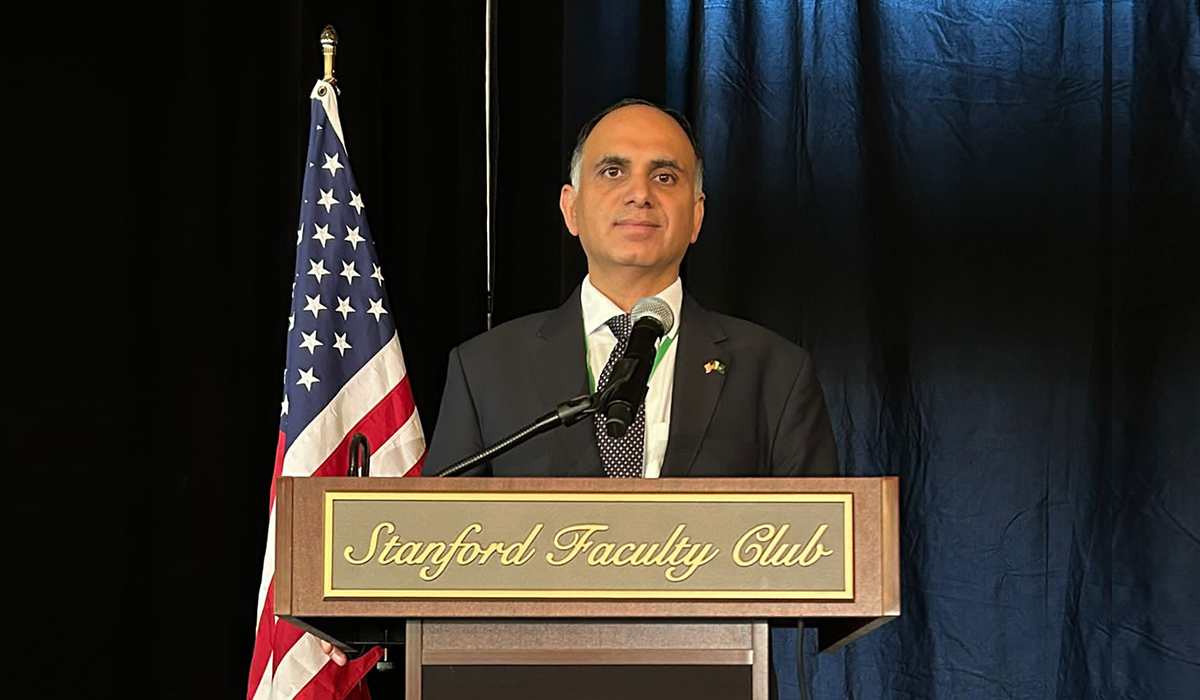
19 Feb Interview with Mr. Asim Ali Khan, Consul General of Pakistan in Los Angeles
How do you see the role of the Consulate General of Pakistan in Los Angeles in strengthening economic, commercial and cultural ties between Pakistan and one of the world’s most influential metropolitan regions?
Los Angeles is not only one of the world’s most dynamic metropolitan regions, but also a gateway to the Pacific and a global center for technology, entertainment, trade and innovation — distinct from the East Coast. Having also served in Washington, DC, I can see the difference clearly. There is strong potential for expanded bilateralcooperation between our two countries particularly with the Western United States. At the Consulate General of Pakistan in Los Angeles, we see our role as a bridge builder — facilitating partnerships between Pakistan and California businesses, and connecting universities, investors and creative industries. This reflects not only an evolving role for the Consulate, but also Pakistan’s broader shift toward economic diplomacy in recent years. Traditionally, embassies and consulates focused primarily on providing consular and communityservices.
Today, following the global digitalization revolution, most of our services for the 9-million-strong Pakistani diaspora are digitalized. This allows us to dedicate more time and resources to promoting economic cooperation and strengthening Pakistan’s image as an investment destination. In Los Angeles, whose jurisdiction includes Silicon Valley and the San Francisco Bay Area, we actively promote cooperation with Pakistan’s IT and tech ecosystem. We also support trade in traditional sectors where Pakistan has strong foundations — textiles, food products, leather and surgical instruments. At the same time, the technology partnership between our two countries remains significantly underexplored. Despite challenges, Pakistan’s economy ranks around 20th globally in purchasing power parity and around 40th in nominal terms, with services contributing nearly 60% of GDP. This reflects strong potential.
The Consulate focuses on startups, venture networks, chambers of commerce and professional associations to build meaningful connections. While distance and time zones present some challenges, they do not deter us. Alongside economic engagement, we also highlight Pakistan’s rich cultural heritage through exhibitions, film, arts and community initiatives — reinforcing that economic partnerships and people-to-people ties go hand in hand. From Silicon Valley to South Asia, we are repositioning diplomacy as a bridge for technology, trade and talent.
In what ways can the Pakistani diaspora in Southern California further contribute to investment, innovation, and Pakistan’s international economic positioning?
Pakistan is among the top five countries in the world with the largest diaspora, with about 9.5 million Pakistanis living abroad. In the United States alone, there are over one million Pakistani Americans, most of whom are well-established and highly accomplished. As an enterprising and thriving community, they have a strong reputation and perform above the median in areas such as education, professional achievement and per-capita income. They contribute meaningfully to the socioeconomic development of both Pakistan and the United States. On the U.S. West Coast — particularly in California — there are around 250,000 Pakistani Americans across the ten states under our consulate’s jurisdiction. In Southern California especially, I have seen over the past three years that the Pakistani diaspora is exceptionally accomplished, with many professionals working in healthcare, finance, management and technology. There are an estimated 15,000 Pakistani-American physicians across the United States — one of the largest and most accomplished professional groups within our diaspora. Beyond healthcare, many are active in technology, academia and entrepreneurship. I consider them natural ambassadors of Pakistan and partners to realize untapped economic potential. We are encouraging their greater role in expanding bilateral economic cooperation, particularly by promoting investment and venture capital in the services sector, especially information technology. Our goal is to channel both capital and mentorship into Pakistani startups to help them compete globally.
At the same time, we are focused on improving market access. Pakistani firms must better integrate into U.S. supply chains — an area that requires sustained effort and strategic partnerships. Third is innovation linkages. Many in the technology industry on the U.S. West Coast do not yet have a full picture of what Pakistan can offer. There is strong potential for collaboration in artificial intelligence, biotech, fintech and joint research initiatives. Pakistan is not only a large market for United States technology firms, but also a source of talent, dynamism and resilience.Pakistan is in fact a market of talent as well as market of scale. The diaspora can play a leading role in building these connections. Many Pakistani Americans travel frequently to Pakistan — nearly 100,000 visits each year — creating a natural bridge between businesses and institutions in both countries. Established professional networks of physicians, IT professionals, entrepreneurs and high-net-worth individuals already work closely with the Consulate to promote partnerships. With nearly 250,000 Pakistani Americans in our jurisdiction alone, the diaspora is not just a community — it is an economic force multiplier. Our goal is to work with the diaspora to bring the economic — especially technology — sectors of both countries closer together through collaboration, investment and innovation.
Which sectors currently offer the strongest opportunities for collaboration between Pakistani and Californian businesses, and how is the Consulate supporting these connections?
Each year, Pakistani IT companies travel to the United States to participate in major technology conferences. On November 10, 2024, the Consulate organized a Pakistan-focused Pakistan-U.S. Tech Investment conference at Stanford University Faculty Club — an unprecedented day-long, single-country event that drew strong interest from businesses and tech diaspora across the U.S.. This became the first wave of similar engagements across U.S. innovation hubs, including Texas, New York and Washington, DC. We are now preparing a second edition of conferences, including a Pakistan Investment Conference in Washington, DC on March 31, followed by another major tech investment event in Silicon Valley around June. These initiatives aim to transform the relationship between Pakistan and the United States to a long-term, sustainable and mutually beneficial economic.
For the Washington, DC conference, we are focusing on three sectors: information technology, mines and minerals and energy. Economic priorities vary across the United States — on the West Coast, our main focus is IT and Artificial Intelligence. Islamabad is currently hosting a week-long Artificial Intelligence event (Feb 9-15, 2026) , Indus AI Week 2026 , bringing together thousands of participants and companies from around the country and the world. This highlights Pakistan’s growing potential as a global partner in AI and technology. The IT sector is expanding rapidly, with exports reaching about $3.8 billion and continuing strong year-on-year growth. Pakistan’s $3.8 billion IT exports and a rapidly expanding AI ecosystem make it one of the most underexplored tech partners for California Another important area on the West Coast is entertainment and digital media collaboration, particularly between Hollywood and Pakistan’s emerging creative industry. Last year, Pakistan’s hand-drawn animated film The Glassworker gained international recognition with its Oscar submission. We are also focusing on clean energy and climate solutions, agritech and food processing, and sustainable textile manufacturing, which remains central to Pakistan’s exports. The Consulate supports these connections through business forums, B2B facilitation, trade delegations, technology incubators, and venture networks, as we continue building partnerships in these priority sectors. A key government priority over the past two years has been the creation of the Special Investment Facilitation Council (SIFC), established by the Prime Minister’s Office to promote international investment through a one-window facilitation mechanism. Working alongside the Board of Investment, SIFC focuses on high-potential sectors such as IT, mining and minerals and energy. There has been growing engagement between Pakistan and the United States in areas such as critical minerals — particularly in Balochistan — and energy transformation. In recent years, Pakistan has added roughly 10,000 megawatts of solar power, creating surplus energy capacity that could support emerging technologies like artificial intelligence.
Pakistan also has one of the world’s largest IT-freelancer workforces, a large consumer market and a rapidly growing technology sector. Beyond being a market, Pakistan positions itself as a connector economy, linking Central Asia, the Middle East, East Asia and Southeast Asia — similar to how Mexico has connected major economies with the United States. With improving regulatory frameworks, international financial support and strong partnerships with major economies, Pakistan offers a compelling business case for long-term investment, supported by longstanding bilateral relations. A 2022/2023 Goldman Sachs report, “The Path to 2075,” projects Pakistan could become the world’s 6th largest economy by 2075, with a projected GDP of $12.7 trillion highlighting its long-term growth potential despite regional geopolitical challenges. This outlook is encouraging for international businesses seeking sustainable expansion.
With a population of about 240 million, nearly 60% of Pakistanis are young, providing a large, educated and English-speaking workforce that will remain competitive for decades. English is widely used in education, business and official communication, which makes it easier for international companies — particularly those from the United States — to operate and collaborate. Today, Pakistan is focused on economic development, stability and long-term partnerships, offering international investors a strong business case built on demographics, talent and market potential. Another important area this year in Pakistan–United States economic engagement is sports manufacturing. Pakistan’s sports goods industry, anchored in Sialkot, manufactures an estimated 40–60 million footballs each year—accounting for the majority of the world’s hand-stitched soccer balls—and has consistently produced official FIFA World Cup match balls. With the FIFA World Cup 2026 coming to North America, this scale and proven expertise offer strong potential for deeper Pakistan–U.S. collaboration in sports manufacturing, merchandising, and supply chain partnerships tied to the tournament.
In fact, soccer balls used in several past FIFA World Cup tournaments — including official match balls produced by Adidas — were made in Pakistan. With the FIFA World Cup 2026 being hosted in the United States, this sector presents a strong opportunity to connect Pakistani manufacturers with U.S. importers and businesses. Pakistani sports goods are globally competitive and produced to international standards, and we want to further showcase this strength in the U.S. market.
What key message would you like business leaders and readers in Los Angeles to take away regarding Pakistan’s economic direction and long-term partnership potential?
Pakistan is undergoing a significant economic transformation. With a population of over 240 million, a predominantly young workforce, and a growing pool of tech-savvy talent, the country offers strong long-term potential. While literacy stands at around 60%, mobile phone, broadband and digital infrastructure penetration are expanding rapidly, including in rural areas — creating both a dynamic consumer market and a competitive base for innovation. For businesses in Los Angeles, California and across the United States, Pakistan represents a growing technology partner, a resilient manufacturing base, surplus energy capacity and a strategically located South Asian market bordering major global economies. Pakistan’s business case for expanding mutually beneficial international partnerships is strong. Pakistan is open to long-term, innovation-driven and promising partnerships and invites all countries to explore its growing opportunities grounded in its demographic dividends and strategic location With 240 million people and one of the world’s youngest populations, Pakistan offers scale, talent and long-term growth for forward-looking investors.
No Comments