
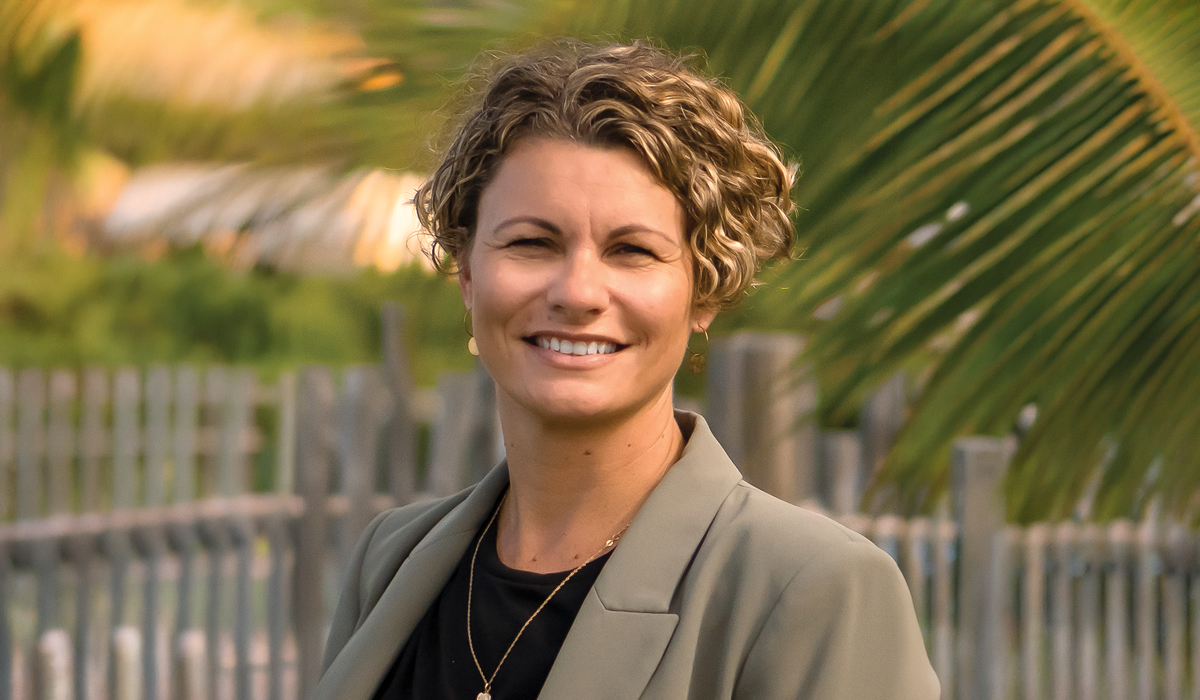
06 Jul Interview with Alexandra Chirlias, General Manager Grand Case Beach Club (GCBC), Sint Maarten
Saint Martin is a major tourist destination in the Caribbean. In the second quarter of 2025 alone, airport arrivals increased by 16.9% and cruise arrivals by 14%, while major U.S. airlines such as JetBlue, American Airlines and United added new routes from key hubs to meet demand. What do you think are the main reasons behind the recent surge in North American travelers choosing Saint Martin as their destination?
I think there are several factors. We’re now back to the levels of 2016, the year before Hurricane Irma, when tourism was truly at its peak. The airport is now fully operational. Previously, we didn’t have all the flights because airlines were reluctant to add more due to the difficulties of managing traffic at the airport. Now, we have a modern, functional and operational airport. As a result, airlines have increased their flight schedules, leading to a rise in passenger numbers. This is a significant advantage. It took time, as the airport took time to reopen at full capacity, but we’re there now. We also have new operators like Southwest, which is very good news.
As far as the hotel is concerned, we had our best year ever in 2024 and an even better year in 2025, with very good year-round occupancy rates. We feel we’ve regained our market share among travelers arriving by airport and that’s very encouraging. Saint Martin has historically had a large pool of returning visitors. They’re already loyal to the destination. Americans, in particular, are loyal customers and we’re able to retain them. Even after Irma, some guests who hadn’t been back since the hurricane, are returning now. They’re happy to see the island as it is and that makes them want to come back. They had associated the island with positive memories and that connection has remained. The ” friendly island” is still here and we’ve managed to preserve a certain authenticity.
The complementarity between the two sides of the island works well: the Dutch side is more developed, with its nightlife and casinos, often perceived as more “American.” The French side is quieter, particularly with the restaurants in Grand Case, where the hotel is located. French cuisine is a draw and people come to eat. We definitely have a segment of customers who come to dine in Grand Case every night. I think these are our main strengths.
The locals are also very approachable compared to other destinations where there’s a noticeable divide between them. Here, those who want to experience the local side can easily do so. In Grand Case, you’ll see locals and in Orient Bay too. There are locals everywhere, everyone mixes together and it works out well. There’s a good harmony between the two groups.
Another advantage: the island is small, but there’s still plenty to do: from zip- lining, to catamaran sailing, boat trips, Loterie Farm, etc and all of this can be done in one single day – unlike other large islands such as Jamaica where you have to drive four or five hours to reach an activity. Here, in one day, you can do two or three activities if you wish. It’s also possible to relax and enjoy the island’s beaches. All types of vacations are possible, and the proximity of the attractions makes things easy.
How do you perceive the evolution of tourism in Saint Martin? How has the sector transformed in terms of supply and products?
The island is clearly moving towards a more luxurious positioning, while still retaining its authentic character. Establishments are modernizing and investments are accelerating. At the Grand Case Beach Club we are striving to move upmarket. However, I wouldn’t say we’re in the ‘luxury’ segment: we see our establishment more as “casual chic” and we want to maintain a very natural feel. Our staff is very local and doesn’t recite the stock phrases of five-star hotels. When a loyal customer returns, we greet them with a hug if we know him/her. We’re like one big family. For Americans, I think luxury is based more on sophisticated aesthetics and a particular type of service. We have a very high level of service, personalized and very attentive to the customer, rather than luxury per se.
The resort stretches along 1.6 kilometers of beachfront and features 74 suites with ocean and garden views, as well as the Moonrise Bar & Lounge and Sunset Café. How would you describe the Grand Case Beach Club in 2025 and what sets its amenities apart in the highly competitive hotel landscape of Saint Martin?
We want to offer “casual chic”. Our guests come here to disconnect and that’s exactly what we offer them. They often see us as a ‘home away from home’ and that’s exactly what we’re aiming for, both in terms of service and benefits. Our suites are all equipped with kitchens, so guests quickly feel at home and can prepare their own meals, even in a studio apartment. We offer several types of accommodations, from studios to two-bedroom apartments, making it ideal for families or groups of friends. Guests are also safe and secure, as we have a security guard on duty at night to ensure their peace of mind.
Our clientele is diverse: some are here for business, others come to party on the Dutch side and choose to return to our hotel in the evening for peace and quiet. They’re looking for a tranquil environment around the pool, without constant entertainment, which is precisely the hotel’s philosophy. We also welcome many couples on their honeymoon or celebrating a wedding anniversary. Weddings aren’t our primary focus, but we host several each year — which fosters loyalty among guests who then return annually to celebrate their anniversary. We’re very focused on the sea: the hotel is located on two beaches, Petite Plage and Grand Case. This is a major advantage for us, as both our sea-view and garden-view rooms are just steps from the beach.
We also offer a stroll around the Rock, with secluded nooks where guests can find peace and quiet. Our values are based on casual chic, with personalized and friendly service, without being overbearing. It’s a friendly service, built on small gestures. The staff remembers guests, their preferred room, always greets everyone and checks in on them. This isn’t a prescribed behavior; it’s spontaneous — and it’s something our guests greatly appreciate. Last year, we renovated the Sunset restaurant, which now boasts a new kitchen. Above it, we created Moonrise and improved the pool area. Everything is brand new. We opened in January and are fully operational for this season. This space is also used for events and weddings.
How has the hotel complex expanded or improved its offering in recent years and what new experiences can guests expect to discover soon?
The hotel recently introduced small wellness activities, a feature considered essential since the post-COVID-19 period. It’s a light program with one activity per day — yoga, Pilates, aqua aerobics and more recently, strength and mobility exercises. During peak season, the clientele has a higher average age, which leads to a preference for gentler practices, even though the clientele is gradually getting younger. The hotel is also considering offering short guided hikes each month in the future.
We’re above anything focused on the experience. Unlike all-inclusive resorts, we don’t aim to retain our guests at the hotel, but rather we want to encourage them to explore the island. The goal is not only to promote the Grand Case Beach Club, but also Grand Case and Saint Martin as a whole, on both sides of the island. Management wants visitors to explore, rent a car, or participate in island tours to discover the region. The hotel also actively involves local businesses wherever possible. Ninety-five percent of the staff are from Saint Martin and live on the island year-round. Seasonal contracts are rare and when they do exist, the same employees are brought back each year during peak periods, ensuring continuity in the relationship with guests — everyone remembers the guests and vice versa.
Guests particularly appreciate seeing the same faces year after year, a key factor for American clientele. The hotel is also committed to integrating with the local community, a priority. In line with this commitment, the hotel is creating its own association to support local projects. The goal is to focus on Grand Case, an area that currently receives little support, and to contribute to existing initiatives, such as neighborhood councils and associations. The idea is to strengthen its ties to the local community, a connection that is already evident since the majority of the staff is from Grand Case. The hotel also hosts many young people for internships and apprenticeships. Some complete their degrees while working on-site and when possible, they are hired after their training — a mutually beneficial arrangement, a sign that the integration is working.
The Grand Case Beach has obtained Green Globe certification, thus reinforcing its leading role in the field of sustainable hospitality. What does this mean for you?
We have just received Green Globe certification, which reflects our values of working in harmony with the environment, particularly regarding the beach. Internally, we have implemented sustainable measures such as glass recycling. We strive to do things that make sense locally, taking into account the island’s infrastructure and capabilities. We have also worked with the local community to protect the beach in front of Grand Case and prohibit access to boats and motorized vessels, as many boats were coming very close to the shore, creating noise and visual pollution, as well as impacting the entire ecosystem. We will install buoys to prevent motorized vessels from entering the beach. The beach will remain fully accessible; only boats will no longer be allowed to approach too closely. Our next project will be to further rehabilitate the reefs around the rock.
We try to think ‘green’ with every decision or new project and to ensure it makes sense locally. We also want our staff to understand what we’re doing. There’s a lot of training involved, because culturally, it’s not necessarily something people are familiar with on the island. So we train our staff so they understand why they’re doing things. We’re in the process of creating an association to help local businesses become a bit greener, depending on the project. This could involve sponsorship, beach sponsorship, etc. cleaning, or other actions of this type.
Saint Martin continues to attract a significant number of American visitors thanks to its connectivity, favorable investment environment and cultural proximity, even though the west coast remains a largely untapped market. In your opinion, what makes Saint Martin particularly attractive to Californians and other North American travelers compared to other competing Caribbean destinations?
For the past two or three years, we’ve noticed a growing enthusiasm from the West Coast market and we’re trying to understand what attracts them. Our Californian visitors often say that Saint Martin is “Europe in the Caribbean.” Many of them are foodies who appreciate our cultural proximity to Europe. For this reason, the French side is very appealing to them. Several Californian clients also told me they’ve heard about Saint Martin or even visited on a cruise and then thought of coming back for vacation. We’re really going to try to capitalize on this market, which is in our top 10, and was even ahead of Florida for a long time – even though it’s geographically more remote.
Generally speaking, we highlight Grand Case and everything it has to offer: the proximity of restaurants, the ease of getting around and our shuttle service. Even though it’s not far, we can accommodate people with reduced mobility, the elderly, or simply people who don’t want to walk. This is also part of our Green Globe approach.
On our social media, we focus heavily on restaurants and activities in the area because our guests enjoy exploring the island and appreciate having a suggested itinerary. It’s also a younger clientele who go out more. Grand Case has changed a lot since the cyclone: it’s still a fishing village, but now there are beach restaurants, more nightlife, places like the Rainbow and the Blue Martini with live music. People can go out for dinner, have a bit of a party and then return to the hotel.
On our Facebook page, we have a ‘Discover the Island’ series where we showcase different spots. We don’t limit ourselves to tourist spots: for example, we have a story about the woman who sells coconuts on Sunday mornings. People love that kind of thing and it gives free exposure to local people.
What are your main priorities today as general manager and how do you envision the GCBC’s contribution to the long-term tourism development of Saint Martin?
We want to continue along the same path that has made the Grand Case Beach Club what it is today, improving what can be improved, listening to our customers and trying to satisfy them as much as possible. Our clientele is becoming increasingly demanding and we must remain attentive to what is happening elsewhere, to trends and innovations, without falling into technological excess.
We also aim to gradually rejuvenate our clientele in the long term. Historically, our clientele has been rather older, but today young people travel more, are more adventurous, want experiences, want hashtags, reels and so on. We are therefore working on creating “Instagrammable” spaces and increasing our presence on social media platforms like TikTok and YouTube, the idea being to be everywhere people can see us. Our guiding principle remains the same: to stay simple and authentic, both in our staff and in how we interact with them, while ensuring maximum customer satisfaction.
Do you have a final message for the readers of the LA Times?
Saint Martin is a must-see for Californians, offering everything they love: a sense of adventure, a growing wellness scene, a foodie scene with French wine and cuisine and a good dose of European flair. I think it’s a complete vacation, even if people only stay four or five days, because it’s often a short break.
Sorry, the comment form is closed at this time.