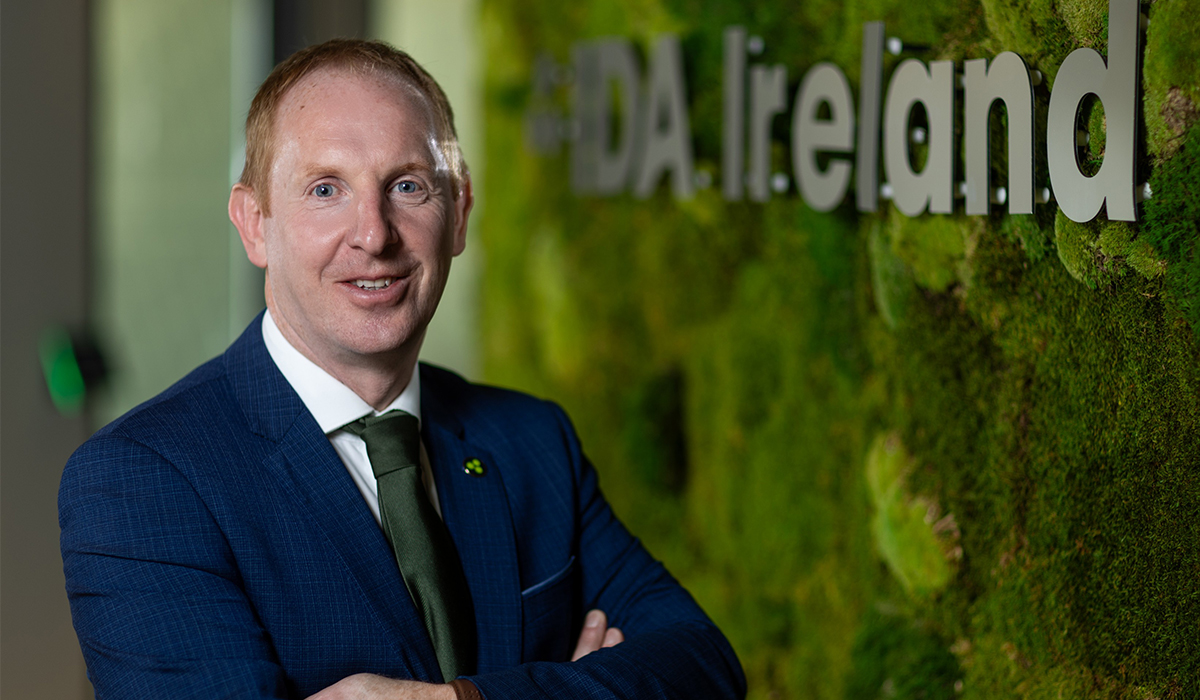
18 Oct Interview with Michael Lohan, CEO, IDA Ireland
Ireland has recorded remarkable economic growth over the past decade, with GDP expanding by almost 5% in 2025. As the country advances its National Development Plan 2026–2035, foreign direct investment remains central to its strategy for long-term competitiveness. How would you summarize Ireland’s economic performance, resilience and adaptability through the challenges of the past decade?
Over the past 30–40 years, Ireland’s economy has evolved into one that embraces innovation and agility across multiple sectors. In terms of foreign direct investment, we focus on forward-looking industries that drive growth, including technology, life sciences — both biopharma and medical devices — international financial services, where Ireland is a leading European and global hub, and high-value manufacturing and engineering. This success is built on Ireland’s ability to develop the capability and capacity to support these industries, underpinned by stable, pro-enterprise government policy. A key differentiator has been universal access to education, which has helped build a strong, highly skilled talent base. Combined with political and policy stability, talent availability and an openness to global collaboration, Ireland has positioned itself as a trusted location for investment and innovation.
What sort of packages, incentives and advantages are currently available to foreign companies setting up in Ireland and how has the country refined its offer to investors in recent years?
When investors look at Ireland, incentives are rarely the starting point. What matters most is access — a reliable base to enter and scale in European and global markets. Ireland serves as a gateway between US multinationals and Europe. Many U.S. companies have been in Ireland for over 70 years, creating long-term, trusted partnerships across sectors. As global commerce and innovation have evolved — from fintech and technology to healthcare — Ireland has remained a stable platform for companies to land, scale and grow. Our approach is not transactional; it is based on long-term partnership. We work with companies from North America and beyond to establish in Ireland, expand their innovation and reinvest over time. That sustained reinvestment has been central to Ireland’s economic development and its move into advanced sectors.
Today, Ireland has a leading semiconductor ecosystem in Europe, built on more than 50 years of engagement and is one of the world’s major hubs for medical technologies, ranking among the top three globally. Many leading U.S. firms, particularly from the West Coast, continue to choose Ireland for their first European investments, including companies like Dexcom, which is expanding its presence and innovation base here. Technology, financial services and life sciences investment has raised ambition across the Irish economy. It has strengthened Ireland’s own talent pipeline while also attracting skilled professionals from across Europe and around the world.
As a result, Ireland has become an innovation hub where people can build rewarding careers across multiple sectors. This has been achieved through long-term partnership. While incentives play a role, the main driver is value creation — benefiting not only operations in Ireland, but also global business units and supply chains.
IDA Ireland’s ambition to become the world’s leading investment promotion agency has been backed by strong results, with the agency recording a record year for FDI projects in 2025. Its growing global profile was also recognized at FDI Intelligence’s inaugural Investment Impact Awards. How would you describe IDA Ireland’s role in attracting global investment and how has the agency’s mandate evolved in recent years?
IDA Ireland has been supporting foreign direct investment for almost 80 years and has a strong track record in building long-term relationships. Today, we work with around 1,800 client companies: approximately 1,000 from North America, 600 from Europe and 200 from Asia-Pacific and the rest of the world. The transatlantic relationship between Ireland and the U.S. has been central to that success and it is something we continue to actively nurture. At the core of IDA’s strategy is putting clients first — helping them transform, innovate faster and invest more sustainably, while also supporting the wider ecosystem around them. FDI has been transformational for Ireland, economically and socially and its impact is seen across the entire country, not just in major cities. It has also strengthened Irish enterprise by integrating local companies into global supply chains and international markets. Ultimately, our focus is on building a connected ecosystem and maintaining trusted, long-term partnerships that create collective value for clients, the economy and Ireland as a whole.
What are the core priorities of IDA’s five-year strategy to 2029 and what foundations must be strengthened to deliver on its most ambitious targets?
In our ‘’Adapt Intelligently’’ strategy, launched 18 months ago, we identified four strategic key growth drivers for Ireland and the global economy: AI and digitalization, semiconductors, sustainability and healthcare. Ireland already has strong ecosystems in each of these areas and is well placed to help them evolve. Across sectors — from financial services to life sciences — we are seeing the impact of AI, digital transformation and emerging technologies shaping the next phase of growth.
Furthermore, we have set an ambition to deliver €7 billion in R&D activity across our portfolio over the next four years. This reflects Ireland’s position as a highly innovative economy, focused on bringing cutting-edge technologies to commercialization and to global markets.
Ireland’s recent FDI performance has been reinforced by strong domestic capabilities in talent and research. The country is also working to ensure that international investment translates into wider local impact, particularly through regional development. What is Ireland’s strategy to attract the skills and talent that it needs, train and retain this talent? How is IDA helping ensure investors that they will find the local resources that they need to grow and expand locally?
A successful enterprise is built on people, talent and skills. In Ireland, we have long recognized the transformative role of education, particularly since the introduction of free education, which helped reshape the country’s outlook and development. Today, Ireland has one of the highest shares of STEM graduates in Europe and a strong, world-class education system. We complement this by attracting international talent, maintaining an open and welcoming environment where people can build truly global careers. As part of the EU, Ireland benefits from access to an EU labor market of over 450 million people, alongside proactive visa and work permit systems that support global mobility. It is common to see teams of 20–40 nationalities working within FDI companies in Ireland.
Alongside attracting talent, we are strongly focused on upskilling and reskilling. Through IDA programs, we aim to support the upskilling of 40,000 people over the lifetime of our current strategy, with over 30,000 already completed in the first year. This combination of strong homegrown talent, continuous skills development and international expertise is a key differentiator for Ireland—and central to our continued competitiveness.
How is Ireland deepening collaboration between research institutions and industry, and what does that collaboration mean for foreign companies investing in the market?
In 2025, Ireland recorded its strongest year for R&D investment, with €2.5 billion committed by IDA client companies to research and innovation. A key strength is how deeply this investment connects into Ireland’s ecosystem — linking companies with universities, research institutions and technology centers across the country. This includes advanced work in areas such as healthcare, technology and quantum research. This collaboration is supported across the state system, including IDA Ireland, Enterprise Ireland and Research Ireland, ensuring a coordinated approach from research through to commercialization. For IDA, the priority is to help convert world-class research into real commercial outcomes, strengthening both innovation and economic impact in Ireland.
What progress has IDA made in attracting investment beyond Ireland’s main urban centers and what strategy is used to bring high-value projects into regional communities?
IDA Ireland is strongly committed to balanced regional development. In our current strategy, we aim for 55% of all supported investments to be located outside the Dublin region. This is important for the economy and for investors, as it expands access to talent, broadens location options and supports the long-term sustainability of investments. We are already seeing the impact across the country. In Galway on the west coast, a leading global medical device cluster has emerged, supported by companies such as Boston Scientific, Medtronic and Johnson & Johnson, alongside strong university and education links. This has also helped grow a strong indigenous medtech base. In the south, Cork has evolved from a heritage in chemical engineering into a major biopharma and technology hub. It is now home to significant global operations, including around 1,000 people working in chip design for Qualcomm. This regional spread is a core part of IDA’s mission: not only to attract investment to Ireland, but to ensure its benefits are felt across the entire country.
U.S. companies remain a dominant force in Ireland’s FDI story, including major investors such as Apple, Microsoft, Meta and Google. There are nearly 1,000 U.S.-owned firms in Ireland that directly employ 211,000 people. You recently joined Minister of Finance Simon Harris on an official ministerial visit to California to strengthen investment ties. What has made the Ireland-USA investment relationship so deep and enduring and how has it continued to strengthen despite global economic and geopolitical headwinds?
At the core of multinational companies is a need for access to international markets, innovation, supply chains and talent. To achieve this, they look for trusted, proven locations and Ireland plays that role. Investors consistently tell us they know what to expect from Ireland: a stable, reliable and predictable environment. We work hard to maintain and strengthen that trust. This is also why we actively engage with key partners, including through high-level trade missions such as recent visits to the U.S. West Coast. These relationships help reinforce Ireland as a place where companies can grow, transform and scale. In a rapidly changing global environment, enterprises must continuously evolve. Ireland supports this through a consistent pro-enterprise approach, stable government policy and an education system that is increasingly responsive to skills needs.
As an agency, IDA’s role is to nurture relationships with existing clients while also attracting new companies to Ireland. Last year was a record year for investment, including 78 first-time investors establishing operations in Ireland. This balance is important: supporting long-standing companies while continually refreshing the ecosystem with new entrants and innovation. The foundations remain the same — stability, talent and a supportive business environment. These are central to Ireland’s continued success and to IDA’s ongoing focus.
Several key sectors are shaping the future of enterprise in Ireland, starting with technology and AI. We are seeing major investments from companies such as OpenAI, Harvey AI, Anthropic and Microsoft, alongside long-standing partners like IBM, which recently marked 70 years in Ireland. These companies are at the forefront of global innovation and Ireland is firmly part of that ecosystem. Fintech and financial services are also evolving rapidly, supported by Ireland’s strong technology base. Companies like Citi and Mastercard are building global capabilities from Ireland as the sector becomes increasingly digital and technology-driven.
In life sciences and advanced manufacturing, Ireland continues to play a critical role. Intel’s advanced semiconductor operations east of Dublin are a strong example of high-value, cutting-edge manufacturing based here. Across medical devices, healthcare and new therapeutic areas, Ireland is deeply embedded in global value chains, helping multinational companies bring innovation to international markets.
You became CEO of IDA Ireland in 2023 after almost two decades with the agency. You were also named The Irish Times Business Person of the Month in December following the publication of IDA’s full-year results. What priorities have shaped your leadership since becoming CEO and what long-term vision are you working toward for IDA Ireland and the country’s investment proposition?
I have been with the organization for over 20 years and have seen significant change in Ireland’s enterprise base. It is a privilege to now lead IDA, whose work has been truly transformative for the Irish economy. Looking ahead, our ambition is clear: to remain at the leading edge of innovation and technological change while continuing to support balanced regional development and enable innovation across the country. Our vision is for Ireland to remain a trusted, proven location of choice for international investors, while further strengthening our capacity in research and innovation and increasing our footprint in bringing new products and services to global markets. Technology, financial services, high-value manufacturing and life sciences will remain at the core of this future direction.
What is your final message to LA Times readers?
For investors seeking a proven, trusted and stable location, Ireland offers a strong track record of success, supported by consistent pro-enterprise policies. Collaboration is central to how we operate. For companies deploying capital, Ireland helps de-risk investment while creating value both for the organization and for the Irish economy. That balance of stability, partnership and performance has been at the heart of Ireland’s success.
Sorry, the comment form is closed at this time.