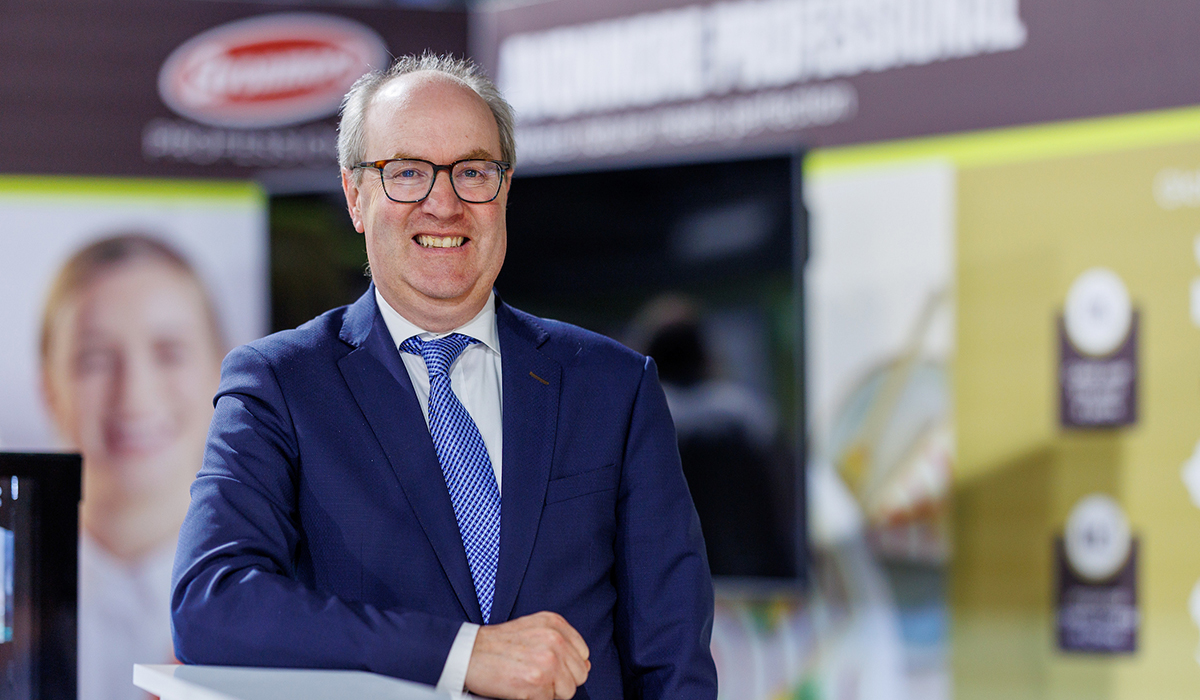
18 Oct Interview with Seán Molloy, CEO Tirlán, Ireland
Ireland’s agrifoods industry accounts for around 8% of GDP and supports almost 160,000 jobs nationwide. In 2025, Irish dairy exports reached €7.3 billion, up 14% year-on-year, reinforcing the country’s position as a leading global food producer. How does Ireland stand out globally in agrifoods and what has helped build its strong international reputation?
Ireland’s agri-food sector is recognized globally as a real success story. Over the past few decades, it has grown into a world-leading industry, with exports reaching around €19 billion last year. Alongside tourism, agri-food is one of Ireland’s most important indigenous industries. That success is built on generations of farming tradition, supported by Ireland’s natural advantages. It is also driven by sustained investment in leading-edge technology and innovation to create value add, particularly in the dairy sector. Today Ireland is recognised not only as a producer of food, but as a trusted supplier of high-quality food and nutrition solutions to global markets.
We have invested across the entire supply chain — from farm inputs and on-farm production to processing, value-added innovation and global markets. It’s the combination of strong heritage and continuous innovation that has made the industry so successful. Ireland benefits from exceptional natural advantages. As an island nation, we have high animal health standards and a strong reputation for quality. Our temperate climate and abundant rainfall also support a grass-based farming system, giving us a natural advantage in dairy production.
Our success has also been underpinned by consistent government support and policies that recognize the importance of agriculture to rural Ireland. Strong institutions such as Enterprise Ireland, the Irish Food Marketing Board Bord Bia and Ireland’s national agriculture and food development authority, Teagasc have played a vital role in helping businesses innovate, access international markets and improve farm performance.
Another key strength is our highly skilled workforce. Ireland has an excellent reputation for agricultural and food education, producing talented people who drive innovation across the sector. We have built our reputation on quality, sustainability and continuous investment. There is no single reason for Ireland’s success — it is the combination of natural advantages, strong policy, world-class expertise and a commitment to innovation that has made our agri-food sector, particularly dairy, a global success.
In December 2025, Ireland secured a three-year extension of its nitrates derogation from the European Commission. What recent policy decisions have strengthened the sector and what more is needed to support its long-term development?
Ireland is a small country of around five million people, yet we produce enough food to feed about 40 million people worldwide. That makes exports essential to our economy. At Tirlán, we export to around 100 countries, so open markets and free trade are critical to our continued growth. Ireland also has a unique advantage in producing dairy delivering among the lowest carbon emissions intensities globally, supported by grass-based farming systems, together with high water quality and excellent environmental standards. The nitrates derogation is important because it recognizes these unique production systems, allowing us to farm efficiently while maintaining strong environmental performance.
Looking ahead, we need policies that promote free trade, investment in education and innovation and the adoption of new technologies, including digital farming. We also need to ensure farming remains an attractive career for the next generation, because the future of our industry depends on bringing talented young people into the sector.
Tirlán is one of Ireland’s largest farmer-owned food and nutrition co-operatives, spanning agribusiness, consumer foods and international ingredients. The co-op recorded revenues of almost €3 billion. Can you introduce Tirlán to our readers and how it embodies Ireland’s rich agricultural heritage and leadership in agrifoods?
Tirlán is a 100% farmer-owned cooperative with a history spanning more than 100 years. While we are deeply rooted in our cooperative values, we are also a forward-looking food and nutrition business with strong ambitions for growth. Last year was an excellent year for Tirlán. Turnover reached almost €3 billion, up 10% on the previous year, while operating profit was close to €64 million. A key strength of our business is financial discipline. We are committed to delivering strong returns for our farmer members while maintaining a robust balance sheet. Today, we are effectively debt-free and have built an investment fund of almost €1 billion. That gives us the financial strength to pursue strategic growth opportunities internationally, including in the U.S., while continuing to create long-term value for our farmer owners.
What factors helped Tirlán deliver such a strong performance in 2025 despite ongoing market challenges; and what are your expectations for 2026?
Several factors drove our performance last year. First is a relentless focus on efficiency. We operate in a high-cost economy like Ireland, so maintaining strong cost discipline is essential to our competitiveness. Second is innovation. We continuously develop new products, services and processes that add value for our customers and members, strengthening both our offering and our market position. A key example last year was our investment of €126 million in value-add whey processing technology to expand our capacity, supporting growth in protein ingredients—an area of strong global demand. Finally, our customer relationships are central to our success. In our ingredients business, we work with leading global brands, many of whom we have partnered with for decades. Those long-term relationships are a major foundation of our performance.
Tirlán processed around one-third of Ireland’s milk pool in 2025 and continues investing heavily in product innovation through its Innovation Centre in County Kilkenny. The co-op has developed a broad portfolio spanning dairy ingredients, consumer products and specialized nutritional solutions. Can you give an overview of Tirlán’s current products and brands that currently stand out in global markets?
We are the largest dairy processor in Ireland, handling around a third of the national milk pool — about 845 million gallons — as well as a significant share of whey production. In a European context, we operate at a meaningful scale. Our business has three main divisions. The first is Consumer Foods, which serves both the domestic and export markets. In Ireland, we own Avonmore, which is the country’s number one dairy brand. We also export branded consumer products internationally, including to China, parts of Asia and the U.S.
In the United States, we have built a growing presence through our Truly Grass Fed brand, which brings premium Irish grass-fed butter and cheese, as well as Ingredients solutions, to American consumers. The brand reflects the strengths of Ireland’s family farm system and growing consumer demand for high-quality dairy products with strong provenance, sustainability and animal welfare credentials.
Overall, Consumer Foods accounts for about €500 million of our €3 billion turnover. We also have a major agri-inputs business, which is similar in scale. It supplies farmers with key inputs such as animal feed, seeds and crop protection products, making us the largest agri-input provider on the island. While primarily focused on the domestic market, it also exports equine feed to markets such as the Middle East. In addition, we have a large dairy ingredients business. This B2B division supplies proteins, powders, butter, cheese and other dairy and plant-based ingredients to customers in around 100 countries, including the U.S., which is a key market for us. We work with many of the world’s leading food and dairy companies, supplying most of the major global brand owners in this sector.
How important is research and development to Tirlán’s growth strategy, and what recent breakthroughs best highlight its innovation capabilities?
Research, development and innovation are central to the success of our industry and remain a continuous priority for us. We have a dedicated innovation center in County Kilkenny, which has seen significant investment over the past decade. It combines advanced processing capabilities with highly skilled scientists and technologists who develop solutions for both our customers and our own product range. On the B2B side, we work closely with customers to tailor ingredient solutions that meet specific technical and functional needs.
In our consumer business, we have also driven strong innovation in the Irish market, particularly in protein-enriched products. A key focus area is protein — across whey protein isolates and concentrates, clear whey and high-protein dairy drinks. This supports fast-growing segments such as sports, active and clinical nutrition, as well as specialist food applications. Overall, protein is a major global growth area and we are strongly positioned within it. Increasingly, the future of dairy is about translating milk into highly functional nutritional ingredients. Whether in sports nutrition, healthy ageing, medical nutrition or everyday wellness products, we see significant opportunities for science-led growth and innovation.
In October, Tirlán launched its FarmLife app. How is the co-op using digital tools to improve efficiency and decision-making across the agrifood value chain?
Policy has played a major role in the development of Irish dairy farming. Until 2015, EU milk quotas limited production and prevented expansion. Their removal released significant growth potential and since then our milk pool at Tirlán has increased by over 90%. During that time, farms have also modernized significantly, with major investment in on-farm technology and efficiency. We have complemented this with our own digital tools to support farmers more effectively. For example, we now use an app that tracks milk constituents daily. If there are changes outside normal ranges, we can alert our farmers in real time and provide tailored advice — digitally or in person — to help them respond quickly. This improves farm efficiency and supports consistent, high-quality milk supply. Looking ahead, we see huge potential in digital technology and AI on farms. Dairy farming has been transformed over the past decade, and this evolution is also helping attract a younger, more tech-savvy generation into the sector.
Ireland’s current National Development Plan places a strong emphasis on talent development, entrepreneurship and community engagement. In October, Tirlán launched its €15 million Generational Renewal program, while March saw the rollout of its FarmElevate knowledge-transfer initiative. What does the Generational Renewal program mean for the future of Irish farming and what impact do you hope it will have?
One of the biggest challenges facing agriculture globally is attracting the next generation into farming. This is an issue across the EU, the US and other developed economies, including Ireland, where young people have many career options in a fully employed economy. We recognize that none of the innovation or market opportunity matters without people producing the raw material in the first place. That’s why we actively engage with policymakers in Dublin and Brussels, but also take direct action ourselves.
We have recently launched a generational renewal program to support young farmers in the early years of their careers. This includes financial incentives linked to milk price, access to low or zero-interest loans and strong investment in education and training. We focus on knowledge transfer, combining state educational resources with the experience of established farmers. The goal is to ensure new entrants are properly supported and farming remains an attractive career for the next generation. We are also focused on promoting farming as a positive and rewarding career. It is a skilled, noble profession with strong long-term prospects, good lifestyle benefits and the ability to generate a solid income. It is important to communicate that message clearly, as farming is often overlooked compared to other career paths. We actively highlight these opportunities and the approach has been very successful. In the first full year of our program, we saw a record number of new entrants into milk production within the Tirlán Co-op. The initiative has also received strong support from Ireland’s Minister for Agriculture. More broadly, attracting new farmers will be a critical global challenge, and ensuring the next generation sees agriculture as an attractive career will be essential to meeting future food demand.
In 2025, Tirlán launched its first Dairy and Sustainability Awards, recognizing suppliers for their commitment to sustainable milk production. The co-op is also a founding member of Bord Bia’s Origin Green program, one of Ireland’s flagship sustainability initiatives. How important has Origin Green been in shaping Tirlán’s sustainability strategy and what progress have you seen in areas such as emissions reduction, biodiversity, packaging and water management?
Ireland starts from a strong position in sustainability. We are a leader in carbon efficiency, water quality and air quality and that provides a strong foundation for our industry. However, maintaining and improving these standards is essential. For us, sustainability is not a separate agenda — it is central to how we create value. Our customers expect products that are produced to high environmental standards and that is an important part of our market positioning.
We were a founding member of Origin Green and have set clear sustainability targets across our business. We reward farmers for best-in-class environmental performance through our sustainability action payment and we support farmers through farm advisory services focused on carbon, biodiversity and water quality performance. We have also made significant investments in renewable energy and lower-carbon manufacturing, including the commissioning of a new solar farm at our largest processing facility. Ultimately, we see sustainability not as a burden but as a shared responsibility. Society rightly expects high standards in water, air and biodiversity and we are committed to delivering that while ensuring the value created is recognized in the market.
Tirlán exports dairy products and nutritional ingredients to more than 100 countries and sold 415,000 tons of dairy ingredients internationally in 2025, with revenues in that segment rising 13%. International markets remain a major driver of the co-op’s continued growth. How important is the U.S. market for Tirlán and how is the co-op strengthening relationships in North America during a period of trade uncertainty?
Ireland has a long history as an exporting nation and strong cultural ties with the United States, shaped in part by generations of Irish migration. That connection has developed into a close relationship, particularly in food and agriculture and the U.S. remains a very important market for Tirlán. We export dairy ingredients, including whey proteins and sell butter in the U.S. under our Truly Grass Fed brand.
In addition, many of our global customers further process our ingredients into products that ultimately enter the U.S. market. Beyond trade, the relationship is two-way. The U.S. is a highly advanced and innovative food market, often leading in technology and consumer trends. We see it not only as a key export destination, but also as a source of ideas and innovation that we can bring back into our business. With our investment capability, we also see opportunities to grow in the U.S. through value-added processing, market access and technology partnerships. It is both a critical market today and a strategic opportunity for the future.
As a small exporting nation, free trade is our starting point. However, we operate in a global environment where tariffs and trade barriers can change and we are very used to adapting to that reality, given that we export to around 100 countries. We have managed additional tariffs in the U.S. effectively alongside our customers and we continue to focus on the value and quality of what we supply. That remains central to maintaining strong and lasting relationships in the market. There is a strong two-way partnership between Ireland and the U.S. On the farming side, the U.S. is particularly strong in technology and digital innovation and we are very open to adopting those advances in areas such as precision agriculture, food technology, labor efficiency and AI-enabled farm management.
We are also open to partnerships with U.S. companies, whether customers or suppliers, where we can work together to create value across the chain. At the same time, the U.S. dairy sector is increasingly export-focused, while Ireland has long-standing expertise in global dairy trade. That creates potential opportunities for collaboration between both industries. Overall, this is a relationship that works best as a two-way flow of trade, technology and ideas and there is clear scope to deepen that further.
You became CEO in 2024 after almost two decades with Tirlán and its predecessor, Glanbia. Since taking the helm, you have overseen a period of strong financial performance while guiding the co-op through a rapidly changing agricultural landscape. What are your top priorities for Tirlán today and where would you like to see the co-op over the next 5-10 years?
I am privileged to lead Tirlán, a business with a long history in Ireland and strong international reach. I would group my priorities into three areas. First, to ensure Tirlán remains a strong, future-focused cooperative that delivers for its farmer members. That means staying competitive, operating efficiently and maximizing returns for the dairy and grain we procure. Second, maintaining a strong focus on our customers, who are essential to our success and growth. Third, ensuring financial strength and discipline, with a healthy balance sheet that supports long-term investment and stability.
My second priority is to continue adding value to our raw materials. While we have grown significantly in volume over the past decade, the focus now is on converting milk and grain into higher-value consumer and ingredient products. That is why our investment in increased whey processing capacity last year was so important and we are now actively looking for further opportunities across the value chain. My third priority is future-proofing the cooperative and its supply base. I want Tirlán, in 10 years’ time, to remain a vibrant, innovative co-op that continues to attract young farmers, new ideas and new ways of working. Tirlán is a purpose-driven organization with a highly committed workforce. The goal is to ensure that the energy, ambition and culture we have today are at least as strong — if not stronger — in the future, despite the challenges the sector will face.
What is your final message to LA Times readers?
Ireland’s agri-food sector is built on strong family farms and a foundation of trust and quality. It combines a proud heritage with continuous investment in innovation and technology. It is a future-focused, customer-driven industry with real ambition to keep developing high-quality dairy and grain-based products that customers around the world will continue to enjoy in the years ahead.
Sorry, the comment form is closed at this time.